
Recurring Drain Blockages: Warning Signs and When to Inspect
 Michael Carter
0 comments
Recurring Drain Blockages: Start Here
Does the same drain back up again after cleaning? Note how quickly the problem returns and whether one fixture or several are affected. A camera can help document an accessible line and distinguish visible deposits from conditions that need further assessment.
- Record which fixtures are affected and when the last cleaning took place.
- Tell the technician about prior repairs, roots and any drain chemicals used.
- Request footage, the inspected route and an explanation of areas the camera could not reach.
Know the limits: A camera inspects; it does not clear a blockage. A fully obstructed line may need professional attention before a useful view is possible. Active sewage backups call for reducing water use and arranging prompt professional help.
interactive Home Drainage Inspection Center · Choose your next step ↓
Recurring Drain Blockages: When a Camera Inspection Helps
Recurring blockages after cleaning are a reason to investigate the line rather than repeat the same treatment without a diagnosis. Multiple slow drains, gurgling or lower-level backups may point to a shared restriction; odors and wet areas have other possible causes and do not prove a broken sewer.
The point of a sewer camera inspection is not to add one more service call. The point is to stop guessing. For homeowners, that means confirming whether the problem is a simple fixture clog or a buried sewer defect before paying for excavation. For plumbers, drain cleaners, home inspectors, and contractors, that means documenting the defect, locating it faster, and quoting the right repair without relying on trial and error.
The Main Warning Signs Usually Show Up in More Than One Place
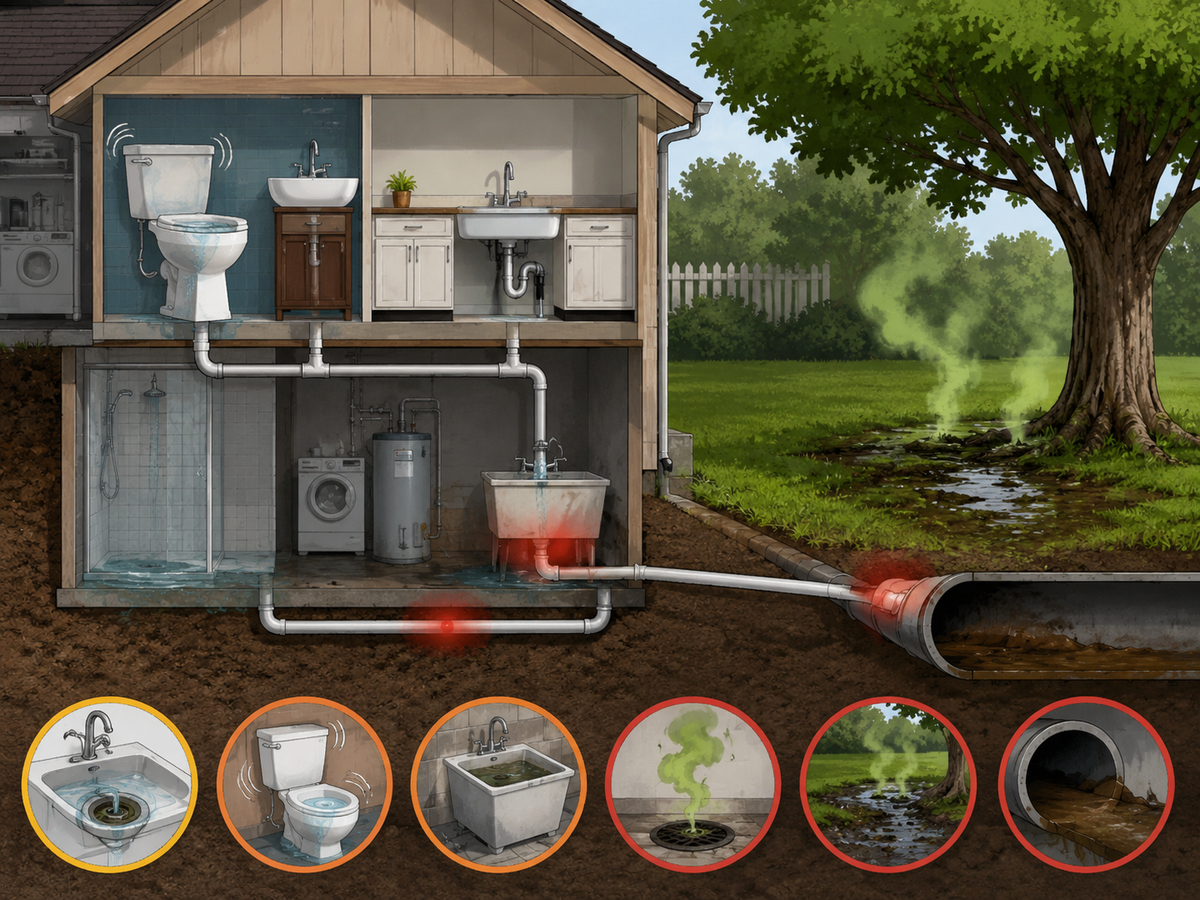
The main warning signs of a sewer-line problem are usually system-wide, not isolated to one sink or one toilet.
That distinction matters. A single slow lavatory drain may be a local clog. A toilet that bubbles when the washer drains, a basement shower that backs up when another fixture runs, or several drains slowing down at the same time points much more strongly to a main-line issue. This Old House lists foul odors, gurgling sounds, multiple drains clogging simultaneously, water backing up into showers or tubs, and wet spots in the yard as common sewer-backup warning signs.
For homeowners and DIY users, the practical question is simple: are the symptoms spreading across the house? If yes, a camera inspection usually tells you more than repeated snaking at one fixture. For plumbers and contractors, the same pattern matters because system-wide symptoms justify a line-level diagnosis, video evidence, and often above-ground locating before repair.

| Warning sign | What it often suggests | When a camera helps most |
|---|---|---|
| Multiple drains are slow | Main-line restriction instead of local clog | Before repeated drain cleaning |
| Toilet gurgles or water level moves | Venting or line-flow issue | When symptoms repeat across fixtures |
| Water backs up at lowest fixture | Main sewer cannot discharge normally | Reduce water use and arrange professional assessment first |
| Sewer smell indoors or near yard | Wastewater or sewer gas is not moving correctly | When smell is persistent, not one-off |
| Wet, sunken, or unusually green yard area | Underground leak or sewer seepage | Before digging or trenching |
| Recurring backups after cleaning | Root intrusion, offset, belly, or break | To confirm why the problem keeps returning |
What Homeowners and Inspection Professionals Need to Know
Homeowners usually care about whether the symptom means "call now" or "wait." The answer is that multiple fixtures, repeated backups, yard changes, and sewage odor usually justify a camera scope soon rather than later.
Plumbers, drain cleaners, and home inspectors usually care about whether the symptom justifies documentation. The answer is yes when the issue may affect a repair quote, a buyer decision, a warranty discussion, or an excavation plan.
Back to topRecurring Backups and Repeated Clogs Usually Mean the Line Needs to Be Seen
Recurring backups and repeated clogs usually mean it is time to inspect the line itself, not just clear it again.
Angi says signs that indicate it is time for a sewer line camera inspection include repeated backups, persistent clogs, or wet spots in your yard. That is useful because it draws the line between ordinary nuisance clogs and a condition that keeps coming back. If a drain works for a week after snaking and then fails again, the remaining question is often what the cable did not solve: roots, a shifted joint, grease scaling, standing water, or a partial collapse.
This is also where camera inspection prevents the wrong repair path. If the footage shows a soft blockage and otherwise healthy pipe, the next step may be cleaning plus maintenance. If the footage shows a separated joint, heavy root intrusion, or standing water, repeating the same cleaning method may only delay a larger repair.
Yard Changes, Odor, and Lowest-Level Backups Are Stronger Signals Than One Slow Sink
Yard changes, sewer odor, and lowest-level backups are stronger indicators of buried sewer trouble than one slow sink.

InterNACHI notes that a sewer scope can be critical when there is a damp depression in the lawn above the sewer line or backflow into the home. This Old House likewise points to foul odors, wet spots in the yard, and wastewater showing up at lower fixtures such as basement drains, tubs, or toilets. These are the symptoms that most often move the problem beyond "annoying" into "confirm the line condition now."
When wastewater backs up at a low fixture, reduce water use and arrange professional assessment. Do not treat active sewage flooding as a reason to keep running fixtures for a DIY camera test.
Why Lowest Fixtures Matter
Lowest fixtures usually show the first visible backup because wastewater moves by gravity. When the main line cannot carry flow away, the backup often appears at basement floor drains, lower showers, laundry drains, or first-floor toilets before it appears upstairs.
Back to topA Sewer Camera Inspection Is Valuable Because It Confirms the Defect Type
A sewer camera inspection is valuable because it shows whether the problem is roots, a crack, standing water, an offset, grease, or a collapse.
InterNACHI’s sewer-scope standard covers reporting visible defects, including roots, cracks, offsets, deposits and damaged sections. The report should identify what was inspected and what was inaccessible. Camera images alone may not support precise size or slope measurements.
For a homeowner, that means the inspection can separate "clear and monitor" from "repair and locate." For a plumber or drain contractor, it means the footage can support a more specific scope of work: spot repair, excavation, lining discussion, root maintenance, or replacement planning. For home inspectors and homebuyers, it means the report is tied to visible defects rather than broad suspicion.
- Repeated clogging can map to roots, grease buildup, or a belly that traps waste.
- Gurgling plus sluggish flow can map to restriction or standing water.
- Wet yard spots can map to a crack, separation, or collapsed section.
- Frequent callbacks after cleaning can map to an unresolved structural defect.
Homebuyers, Inspectors, and Contractors Often Need a Camera Before Big Decisions

Homebuyers, inspectors, and contractors often need a camera inspection because the sewer lateral can change a purchase, repair bid, or liability decision.
A sewer scope can support a purchase or repair decision by documenting the accessible line and its visible defects. Ask providers for a current quote and confirm whether recording, locating, cleaning and written reporting are included; service fees vary by location and scope.
For homeowners, the takeaway is that a sewer camera inspection can be worth ordering before you buy an older home, after recurring backups, or before approving a major sewer repair. For inspection professionals, the takeaway is that camera work becomes more valuable when you need repeatable documentation, visible footage for the customer, and a cleaner handoff into locating or excavation.
- Before buying an older home or a property with unclear sewer history
- After the second or third repeat clog, not the sixth
- Before approving excavation or full replacement
- After suitable root clearing, to document the newly visible pipe condition
- Before issuing a repair quote that depends on footage and footage location
Choosing Between Hiring a Pro, Renting a Camera, and Owning One Depends on Frequency
Choosing between hiring a pro, renting a camera, and owning one depends mostly on how often you need footage and whether you also need diagnosis.
Most homeowners still get the best result by hiring a qualified plumber or sewer-scope inspector for a one-time diagnosis. The value is not only the camera; it is the interpretation, the footage, and the next-step recommendation. Repeat DIY users, landlords, flippers, and home inspectors have a stronger case for ownership because they use the tool often enough to benefit from having it available on demand.
Powerwill PW9D1 currently offers 20 m, 30 m and 50 m cable variants, with or without a locator. Powerwill PW9D2 offers 30 m, 50 m, 60 m and 70 m cable variants, with locator and distance-counter options listed separately. Check the selected variant for current pricing, included equipment and availability. Cable travel is not burial depth, and cable length does not guarantee that the head will pass every bend. For other reach and handling requirements, compare sewer camera systems. Do not select a kit from price alone: confirm the camera head, bends and access route first.
| Model | Usually fits | Usually does not fit |
|---|---|---|
| PW9D1 | Homeowners, DIY repeat users, residential plumbers working smaller lines | Long municipal runs or crews that need the longest reel every day |
| PW9D2 | Routine home sewer service, mixed homeowner/pro use, more frequent diagnosis | Buyers who only need one inspection this year |
| 7DVE | Compact field kits, smaller service setups, lighter daily carry | Long-reach specialty work |
| 10DX1 | Longer runs, quoting with footage distance, locator-driven repair planning | Tight-budget one-time residential use |
| 10DZ | Detailed professional inspections with longer reach | Simple one-off homeowner troubleshooting |
What to Do Before the Technician Arrives
What to do before the technician arrives is mainly about access, not repair.
Angi's sewer camera inspection Q&A says the pro will need access to the sewer cleanout and notes that some homes do not have one, in which case a toilet may need to be removed for access. InterNACHI also says owners should avoid running sinks, showers, tubs, washing machines, dishwashers, or toilets during the sewer scope inspection. Those are practical details that help the scope happen efficiently and safely.
- Locate the cleanout if you know where it is.
- Stop heavy water use before and during the inspection.
- Tell the technician whether backups affect one fixture or several.
- Note whether symptoms are indoors, outdoors, or both.
- Ask whether footage, stills, and distance notes are included.
Key Takeaways
- Multiple slow drains, lower-level backups, sewer odor, wet yard spots, and recurring clogs are the clearest warning signs that the main line may need a camera inspection.
- Repeated cleaning without footage often delays the real answer, because the underlying problem may be roots, a belly, an offset joint, or a structural break.
- A sewer camera inspection is most useful when it changes a decision: whether to clean, repair, locate, negotiate a home purchase, or approve excavation.
- Homeowners usually benefit most from hiring a pro for one-off diagnosis, while inspectors, landlords, plumbers, and contractors have a stronger case for owning a camera.
- Powerwill's lineup separates naturally by use case: PW9D1 and PW9D2 for residential and crossover work, 7DVE for compact service use, and 10DX1 or 10DZ for longer-reach professional workflows.
FAQ: Warning Signs You Need a Sewer Camera Inspection
How do I know if I need a sewer camera inspection or just drain cleaning?
You usually need a sewer camera inspection when the symptom affects multiple fixtures, keeps returning after cleaning, or shows up as sewer odor, yard seepage, or lower-level backup. One isolated sink clog can still be local, but repeat main-line symptoms usually justify seeing the pipe before spending more money blindly.
Is a sewer smell outside the house enough reason to schedule a camera inspection?
Yes, persistent sewer odor outside or near the drain path is a reasonable reason to investigate, especially if it comes with wet yard spots, slow drains, or backups indoors. A smell by itself does not prove a broken line, but it is strong enough to justify checking whether wastewater is moving correctly.
What warning signs matter most for homebuyers?
Homebuyers should pay closest attention to recurring drain history, older homes with unknown sewer records, damp or sunken yard areas over the lateral, and any sign of backup at lower fixtures. A sewer scope is especially useful when the sewer line condition could affect negotiation, repair budgeting, or the decision to close at all.
Can a homeowner use a sewer camera instead of calling a plumber?
Yes, but the fit depends on frequency and confidence level. A homeowner doing repeat checks on personal rentals or older properties can justify a crossover kit like the Powerwill PW9D1 or PW9D2, while a one-time buyer usually gets better value from hiring a pro who can interpret the footage and recommend the next repair step.
When does a plumber or contractor need 512Hz locating, not just video?
Locating is useful when a visible finding needs to be related to an approximate surface position. This requires an active compatible sonde and receiver; the model name or a 512Hz label alone does not confirm receiver inclusion. Verify the selected variant and follow the receiver instructions before using the readings for repair planning.
Related Powerwill Reads
Sources
Choose Your Next Step
Need a one-time diagnosis? Arrange a qualified sewer scope and ask for footage, written findings and inspection limitations. For repeated inspections, compare equipment against the actual pipe and access.
camera selection guide · compare sewer camera systems · Ask Powerwill about kit fit
Product configurations checked September 8, 2026. Current prices and kit contents are shown on the selected product variant. Nominal cable length is not a guarantee of usable reach or locating depth.
Inspection reference: InterNACHI sewer-scope scope and limitations.
Comments
No comments