
How to Read a Sewer Camera Inspection Report: A Field Guide for Homeowners
 Michael Carter
0 comments
Michael Carter
0 comments
A sewer camera inspection report should answer four questions clearly: what part of the line was inspected, what defect was seen, where it was located, and what action makes sense next. InterNACHI's sewer scope standards says defects should be identified in written format, while NASSCO's PACP grading explainer shows how professionals separate severity from frequency. If your report only says “possible problem” or “line may need replacement,” you do not have enough information yet to approve major work.

Start With the Scope and the Limits
The first thing to read is not the defect list. It is the report boundary. InterNACHI says a sewer scope inspection report should identify the portions of the line that were inspected, indicate any areas that were not inspected, and state the reason they were not inspected.
That means a usable report should tell you where the camera entered the system, whether the inspection reached the city or HOA tap or septic connection, whether the line was blocked or inaccessible anywhere, and whether the inspector could identify pipe material. Without that frame, later conclusions are easy to overread.
Homeowners should also look for whether the full video is included. A written summary is helpful, but the video is what lets you verify the condition, compare contractor opinions, and revisit the problem later.
Back to topRead the Location Data Before the Diagnosis
Location data is what turns sewer footage into a repair decision. A note that says “roots present” is weak by itself. A note that says “root intrusion begins at about 43 feet from the exterior cleanout” is something a contractor can price against.
Look for distance counter readings, timestamps, and a clear start point. If the report uses a locator, it should also say whether the defect was marked above ground. InterNACHI does not require above-ground locating, so do not assume that every report will give you a dig point automatically.
Translate Common Defect Language
The report terms usually sound technical, but most of them map to a short homeowner meaning. InterNACHI's standards provide useful thresholds: visible roots are a defect, offsets greater than one-quarter inch are a defect, standing water over one inch is a defect, and broken, separated, crushed, or collapsed line sections all need correction.
| Report term | What it usually means | Typical next step |
|---|---|---|
| Root intrusion | Roots entered through a joint, crack, or failed connection. | Cleaning, then evaluation of whether the entry point needs repair or lining. |
| Standing water / belly | The pipe may have settled, creating a low spot that traps solids. | Watch severity, ask whether flow is restricted, and price repair only if symptoms or severity justify it. |
| Offset | Pipe sections no longer align evenly. | Compare severity, repeat symptoms, and whether paper or solids are catching there. |
| Scale / grease / blockage | A maintenance issue is restricting the line. | Cleaning or jetting first, then a re-scope if the underlying condition is still unclear. |
| Broken / separated / collapsed line | The pipe has structural failure, not just buildup. | Get repair bids tied to the exact location and length involved. |
When the Report Is Too Vague
A homeowner does not need a full PACP certification to read a report, but the NASSCO framework is still useful because it separates severity from how often the defect occurs. NASSCO says PACP reports can include structural, operations and maintenance, and overall ratings, plus quick ratings that highlight the highest observed severity.
That matters because one bad spot is different from many bad spots. A single severe defect can justify a spot repair. Multiple repeated defects through the run can suggest a broader problem. If your contractor uses phrases like “looks rough,” “probably needs replacement,” or “seems old” without location detail, frequency, or footage examples, the report is not yet specific enough.
Good follow-up questions are straightforward: How many occurrences were observed? Was the issue structural or maintenance-related? Is the recommendation cleaning, monitoring, spot repair, lining, or replacement? What exact footage marker supports that recommendation?
Back to topMatch the Finding to the Budget Decision
A sewer camera report is useful only if it leads to the right next spend. HomeGuide says snaking commonly runs about $150 to $500 and hydro jetting about $250 to $800, while repair costs can go much higher once structural work is needed. Angi and This Old House both show why replacement conversations should be handled carefully: the totals can climb into the thousands quickly.
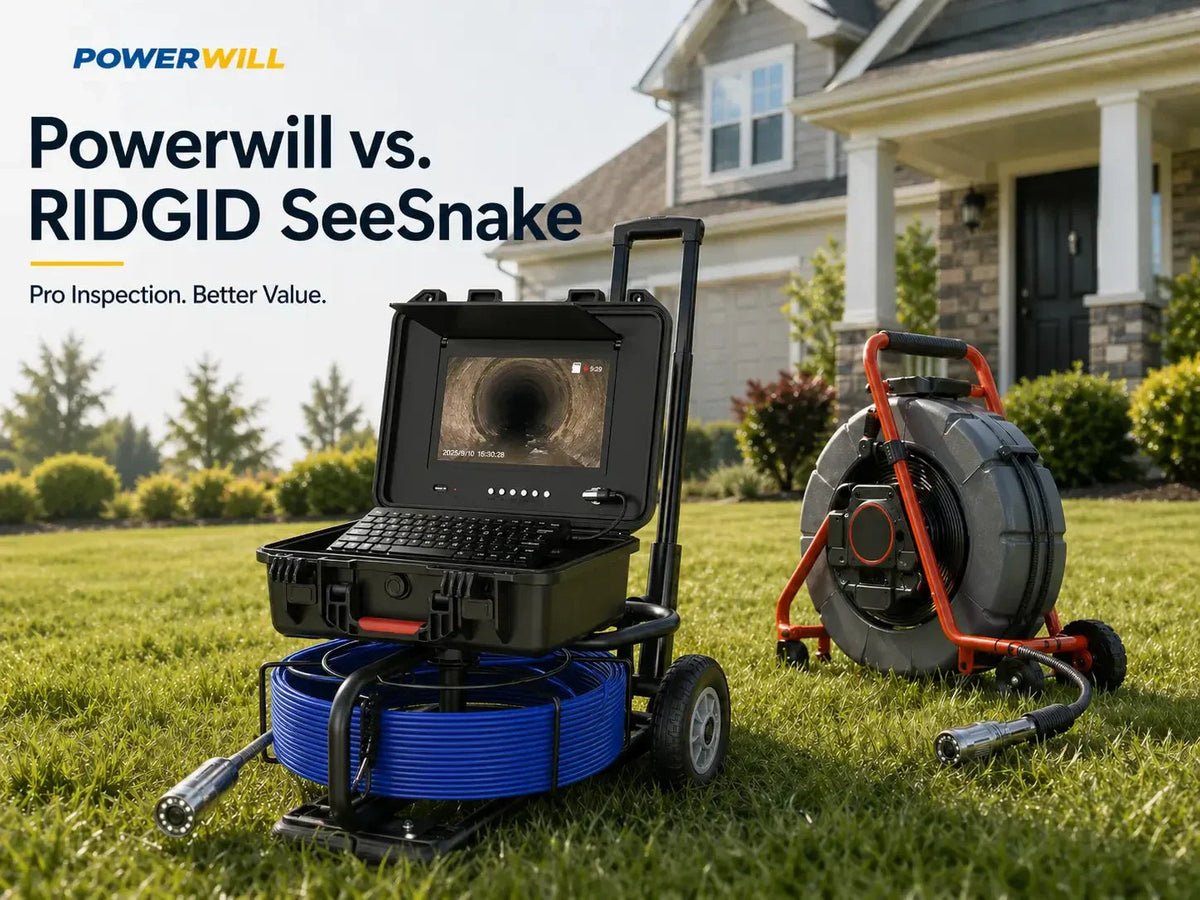
This is where recorded follow-up matters. The current Powerwill PW9D1 lists a 9-inch IPS monitor, IP68 self-leveling camera head, 100-foot meter-marked cable, DVR recording, and 32 GB card at $595.80. For homeowners who want to verify that a cleaning worked or compare contractor recommendations over time, that kind of repeatable documentation can be more valuable than one vague report.
If the report is unclear, the most cost-effective move is often not “approve the repair.” It is “get a sharper report or a second interpretation first.”
Back to topKey Takeaways
- Read the report boundary before you read the diagnosis. You need to know what portion of the line was actually inspected and where coverage stopped.
- Location data is what makes a sewer report actionable. Distance markers, access point notes, and locator information turn footage into something a contractor can price accurately.
- InterNACHI's thresholds help homeowners decode the language. Roots, standing water over one inch, offsets over one-quarter inch, and structural breaks are not all the same level of problem, but all deserve specific explanation.
- NASSCO's grading logic is a good reality check. Severity and frequency are different, so one isolated defect should not be discussed the same way as repeated defects throughout the line.
- Powerwill is useful for follow-up verification. A homeowner who wants repeat footage, meter-marked tracking, and documented re-checks can often benefit more from ownership than from repeated vague service calls.
FAQ
What should always be included in a sewer camera inspection report?
At minimum, the report should identify what part of the line was inspected, what defects were observed, what parts were not inspected, and why. A full video copy is also extremely helpful for second opinions.
Does standing water in a sewer line always mean replacement?
No. Standing water can mean a belly, a temporary restriction, or another slope issue. The next step depends on severity, recurrence, and what else the camera shows around that location.
What is the difference between a maintenance issue and a structural issue?
Maintenance issues include things like grease, scale, or blockages that may clear with cleaning. Structural issues include breaks, separations, offsets, and collapse that usually require some form of repair planning.
Should I approve excavation from one vague camera report?
Usually no. If the report lacks clear footage markers, severity detail, or a full explanation of what was and was not inspected, ask for a sharper report or a second opinion before approving major work.
Can a homeowner use their own camera to verify a repair?
Yes, especially for post-cleaning or post-repair follow-up where the goal is visual confirmation. That is one of the strongest homeowner use cases for a system like the Powerwill PW9D1.
Conclusion
A sewer camera inspection report should make the next decision clearer, not fuzzier. If you can explain the defect, the location, the severity, and the recommended next step in plain English after reading it, the report probably did its job.
If you want a homeowner-friendly way to document follow-up inspections yourself, the Powerwill PW9D1 is built for exactly that repeat-verification workflow. See the Powerwill PW9D1.
Back to top
Comments
No comments