
From 2018 to 2026: How Powerwill Built Professional Sewer Cameras
 Michael Carter
0 comments
Michael Carter
0 comments
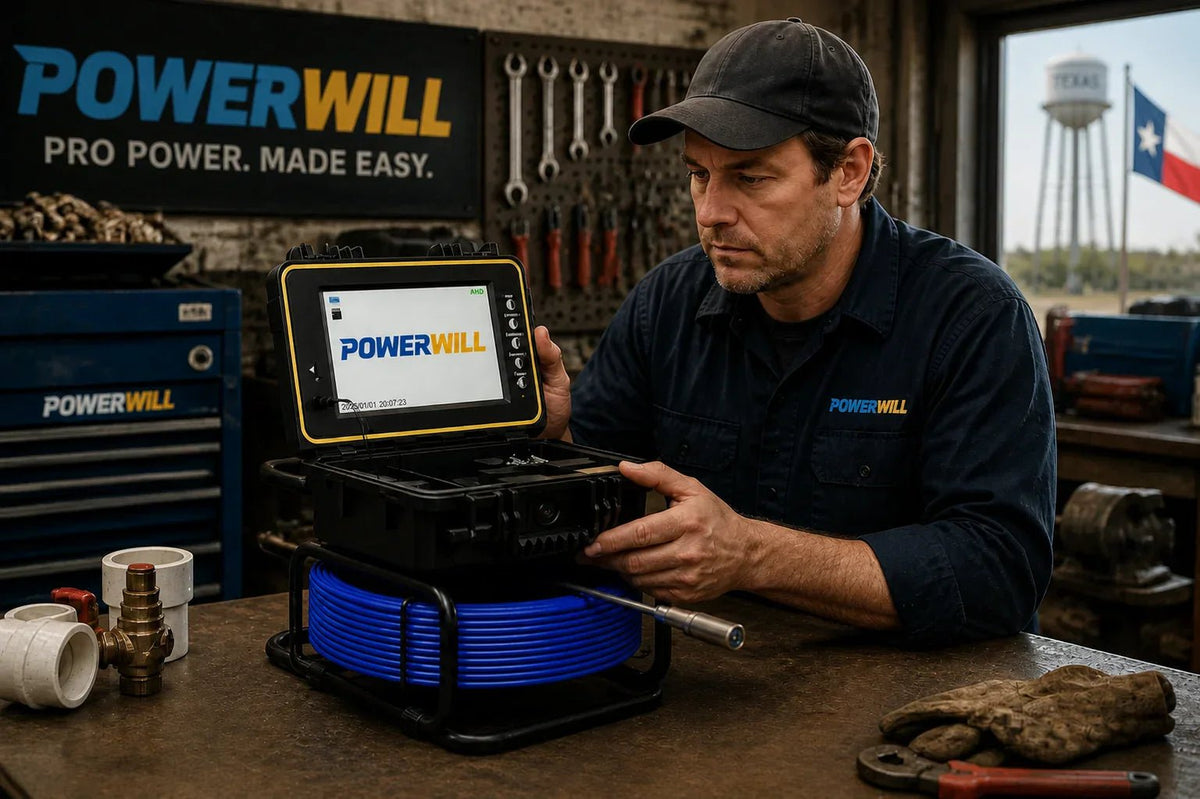

Professional camera brands earn trust with support, parts, and repair logic, not with slogans alone.
Powerwill says it was founded in 2018 to make pipe inspection less blind and less expensive, and the most believable evidence on that claim is not the slogan on the About page. It is the actual feature path the company now sells: self-leveling camera heads, distance counters, 512Hz locating, replaceable parts, a Texas service center, and RA-based warranty handling. In other words, the brand story matters only if it explains why a plumber or homeowner can diagnose faster, repair less blindly, and get back to work sooner. This article looks at that practical timeline instead of treating "brand history" like marketing filler.
Why the Timeline Matters
A sewer camera is not a purely digital tool. It lives in mud, grease, sharp bends, wet cleanouts, freezing vans, and rushed service calls. Because of that, "brand story" only matters when it predicts ownership reality: whether the footage is readable, whether the push cable survives field use, whether the camera head can be replaced, and whether somebody answers when a job stops because a part failed.
That is why the most useful way to read Powerwill's 2018-to-2026 story is through features and service evidence. On its current About page, Powerwill says it was founded in 2018 and focused on helping users eliminate costly repairs. On its current store and support pages, that promise now shows up as concrete items buyers can verify: 7mm fiberglass cable, IP68 protection, DVR recording, Houston-based support, RA returns, and replacement kits sold separately instead of forcing a full unit replacement.
For a homeowner, that matters because better diagnostics reduce unnecessary digging. For a plumber, it matters because downtime is expensive. A camera that is impossible to repair is cheap only until the first failure.
↑ Back to top2018: The Starting Point Was "Stop Blind Repairs"
Powerwill's own language is clear about the founding thesis. On both the About Powerwill page and the About Us page, the company says it was founded in 2018, focused on research, development, and production of inspection equipment, and aimed to make repair work simple while helping users eliminate costly repairs.
That framing lines up with the actual economics of sewer diagnosis. According to HomeGuide's 2026 sewer camera inspection cost guide, a professional camera inspection usually costs $125 to $500, while a sewer scope added to a home inspection often costs $100 to $250. Those numbers explain why the promise of "stop blind work" is commercially strong: people will pay for evidence if the evidence helps them avoid a much larger repair.
That same math appears on the repair side. HomeAdvisor's 2025 sewer line replacement guide puts the typical replacement range at $1,388 to $5,323, with an average of $3,319. Powerwill did not invent the inspect-before-repair logic, but its brand positioning clearly leans into it. A camera brand built around that idea has to prove that it does more than sell footage. It has to reduce guesswork in a way that survives real jobs.
That is why 2018 matters. It marks the point where the company publicly attached itself to a simple value proposition: show the problem first. Everything in the later product and support stack should be read as proof, or disproof, of that original promise.
↑ Back to topFrom Basic Cameras to Pro-Oriented Specs
By 2026, Powerwill's current product and collection pages show a lineup that is clearly aimed beyond hobby use. The company's sewer camera collection describes systems built for residential plumbing through municipal drainage work, emphasizing HD imaging, 512Hz locating, and waterproof construction. That does not mean every model is identical, but it does show a consistent direction: more field-ready inspection hardware instead of simple novelty scopes.
| Public signal | What it suggests in 2026 |
|---|---|
| Founded in 2018 | Enough time to build a product line, parts catalog, and service workflow instead of a one-off marketplace listing. |
| PW9D1 listed from about $399.99 to $744.99 | Entry and homeowner-friendly price points remain part of the lineup. |
| 10DX1 listed from about $1,304 to $1,630.77 | Powerwill now sells longer-reach, locator-ready systems aimed at professional use. |
| 512Hz receiver sold separately at $372.95 | The locating workflow is treated as a real field function, not an afterthought. |
| Replacement camera head sold at $307.68 | The company expects serviceability and part replacement to be part of ownership. |
The model mix helps explain the brand arc. The sewer camera collection currently shows the PW9D1 with self-leveling and 512Hz-locator-oriented messaging at lower price tiers, while the 10DX1 listing pushes up into long-reach professional territory with 246 feet of cable. That is a practical product-ladder move. A company that wants to serve both homeowners and pros needs an entry tool, an upgrade path, and a parts ecosystem that does not collapse the first time a head or guide wheel fails.
Feature direction matters too. Powerwill's About page now highlights self-leveling camera heads, distance counters, locator functions, high-resolution displays, DVR recording, and integrated all-in-one systems. Those are the details that make footage easier to interpret and easier to explain to a customer. Upright footage reduces confusion. A distance counter makes the repair location easier to communicate. A locator closes the gap between "we saw something" and "we know where to dig."
That is what a maturing inspection brand looks like in public. It moves from just selling a screen-and-cable device to selling a workflow.
↑ Back to topThe Support Layer That Buyers Actually Feel in 2026
Support is where many lower-cost equipment brands break down. Powerwill's current support pages show a more developed structure than a simple contact form. The key pieces are visible and specific.
First, the current warranty page says products purchased through Powerwill.com are automatically covered and that warranty claims should include model details, serial numbers, purchase date, and photo or video evidence. That is operationally important. A support form that asks for evidence tends to resolve faster than one that begins with vague back-and-forth email.
Second, the current warranty policy spells out an RA-based return-to-base workflow. Buyers are told to get a Return Authorization number, ship the unit prepaid, and send it to the Texas service center at 10606 Hempstead Rd, Houston, TX 77092. Shipments without an RA number are refused. That is the kind of detail serious buyers look for because it shows the company has a repair intake process, not just marketing copy.
Third, the current Contact page lists support email, a U.S. phone number, service hours, and the same Houston address. The home page adds another trust marker by explicitly advertising "Texas service center with one-year warranty and RA returns." Those repeated details matter because they match across pages instead of appearing once and disappearing.
Finally, the replacement parts collection closes the loop. Guide wheels, camera heads, and locator accessories are sold as standalone items. A 23mm x 120mm 512Hz camera head is listed around $307.68, and the 512Hz receiver kit is listed at $372.95. That is what support looks like in the field: you can buy the component you broke instead of assuming the whole system is disposable.
↑ Back to topWhat "Professional" Means in Practice
Professional does not have to mean the most expensive system in the market. It usually means the tool can do repeat work, survive rough handling, and produce documentation somebody can act on. Powerwill's current public pages point to four traits that matter most.
Readable footage: self-leveling heads and HD recording reduce interpretation mistakes. Recoverable location data: locator support and distance counters help a crew explain where the issue sits. Repairability: parts availability reduces downtime. Support path: a documented warranty and RA workflow means a failure does not become a dead end.
That combination is why the brand story should not be read as a vague "growth journey." The useful version is simpler: since 2018, the public evidence suggests Powerwill has been building toward a full ownership model instead of a one-box sale. Homeowners feel that in easier inspection access and lower false-repair risk. Plumbers feel it in faster break-even math and lower replacement pain.
There is also a pricing story in that progression. A lineup that spans from lower hundreds into the $1,600 range gives buyers different entry points. The company can serve a homeowner who wants residential diagnostics and a pro who needs longer cable, bigger screens, and locating capability. That range is one reason the brand can position itself as practical instead of luxury-first.
↑ Back to topHow to Evaluate Any Sewer Camera Brand
The smartest takeaway from Powerwill's 2018-to-2026 arc is not "trust this brand automatically." It is "use the same checklist on every brand you consider." Ask five questions before you buy.
- Does the company show a real service address and a real support phone or email?
- Is the warranty process specific, including what evidence to submit and where the unit ships?
- Are replacement parts sold publicly, with prices, instead of only through private support tickets?
- Do product pages explain practical inspection features such as self-leveling, distance counting, locating, and waterproofing?
- Can the product price be justified against inspection and repair costs in the real market?
That last point is crucial. A camera only has to prevent a few blind repair decisions before it starts paying for itself. If a professional inspection costs $125 to $500 and sewer line replacement often costs thousands, the brand that makes evidence easier to get and easier to trust has real value. That is the standard buyers should apply to Powerwill and to everyone else in the category.
Ready to evaluate Powerwill's current lineup by that standard? Start with the current sewer camera collection, compare homeowner-friendly options such as the PW9D1, then move to the 10DX1 professional range if you need longer reach, a larger monitor, and locator-ready workflow.
↑ Back to topKey Takeaways
- Powerwill's public 2018 founding story is tied to a clear problem: reduce blind plumbing repairs by giving users direct visual evidence before they dig or replace.
- The 2026 product lineup shows a move toward professional workflow features: self-leveling footage, distance counters, locator support, long cable options, and integrated recording.
- The strongest trust signal is the support stack, not the slogan: RA numbers, a Texas service center, a published warranty path, and visible support contact details all matter more than branding language.
- Replacement parts make the brand more credible: camera heads, guide wheels, and locator accessories are sold separately, which lowers the cost of ownership after damage.
- The practical way to read any brand story is to ask whether it changes ownership risk: faster diagnosis, fewer blind repairs, repairable hardware, and a service path are what count.
FAQ
When does Powerwill say the company was founded?
Powerwill's current About pages say the company was founded in 2018. The same pages frame the mission as making repair work simpler and helping users avoid costly repairs through inspection equipment.
What makes Powerwill feel more established in 2026 than a generic online listing?
The best signals are the ones buyers can verify: a published Houston service address, RA-based warranty handling, visible support contact details, and a public replacement-parts catalog. Those are operational details, not just marketing claims.
Does Powerwill sell replacement parts for its sewer cameras?
Yes. Powerwill currently sells replacement kits and accessories such as guide wheels, 512Hz receivers, and camera heads through its replacement-parts collection. That matters because it lowers the cost of repairing field damage.
Is Powerwill only for professionals?
No. The current lineup spans lower-cost self-leveling homeowner-oriented options and higher-reach professional systems such as the 10DX1. The right choice depends on pipe length, reporting needs, and how often you inspect.
What should I check before I trust any sewer camera brand?
Check the warranty process, service address, parts availability, contact information, and whether the listed features solve real field problems. If a brand cannot explain how repairs, returns, and replacement parts work, the low price may not be worth it.
Sources
- Powerwill About Powerwill
- Powerwill About Us
- Powerwill Sewer Camera Collection
- Powerwill Sewer Inspection Camera Collection
- Powerwill Replacement Kits
- Powerwill Warranty Service
- Powerwill Warranty Policy
- Powerwill Contact Us
- HomeGuide: Sewer Camera Inspection Cost (2026)
- HomeAdvisor: Sewer Line Replacement Cost (2025)
Comments
No comments