
Offset Sewer Pipe: How to Read the Finding Before Approving Repairs
 Michael Carter
0 comments
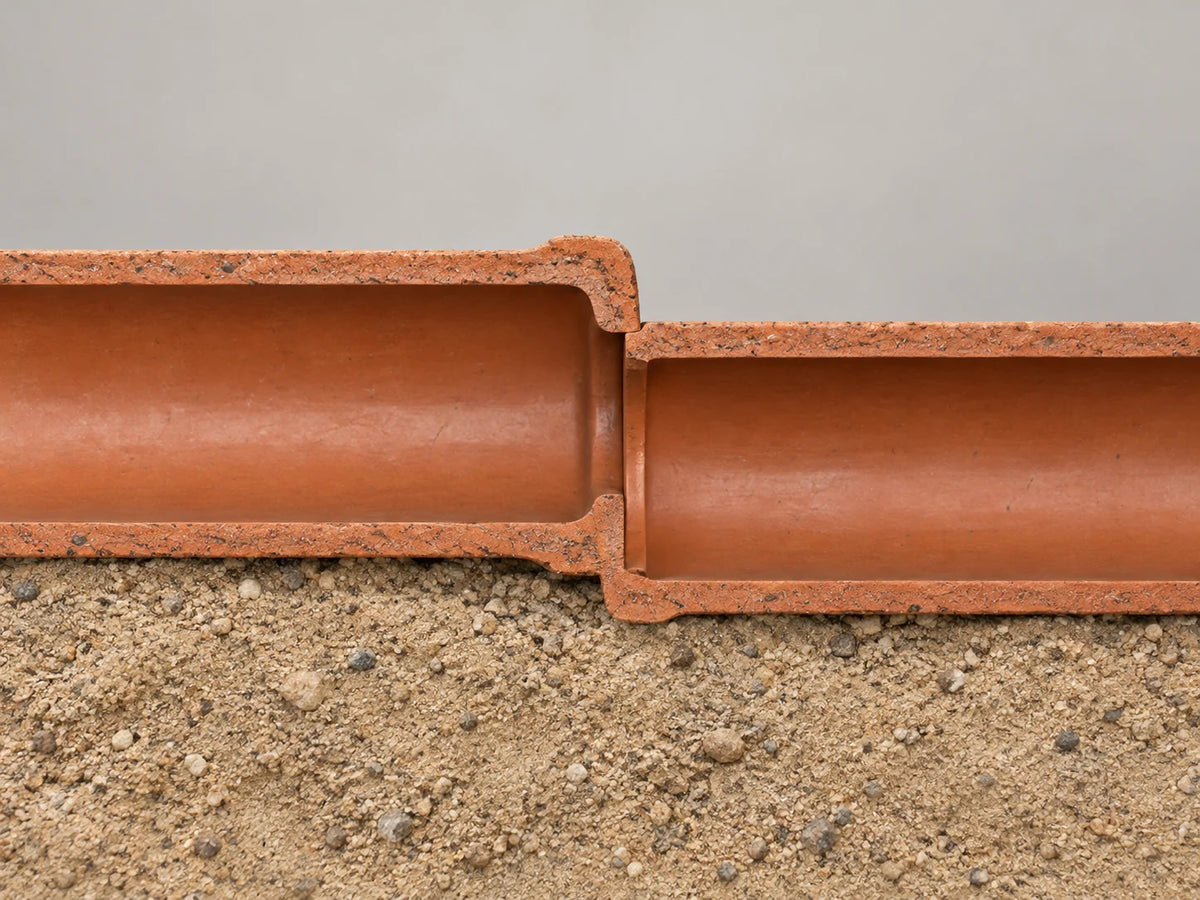
An offset sewer pipe has adjoining sections that no longer line up evenly at a joint. A camera inspection can document the visible mismatch, but a screenshot alone does not establish its dimensions, cause, or best repair. Ask for the full recording, access point, travel direction, location notes, and a written explanation connecting the finding to the proposed work. Powerwill's Inspect Before Repair approach starts with that evidence, not an automatic excavation decision.
Cover: conceptual illustration of an offset pipe joint, not to scale and not actual inspection evidence.
What does an offset sewer pipe finding mean?
An offset describes alignment at a connection. It is a finding to explain, not a complete repair specification. Start by asking the inspector to point out the two adjoining pipe ends in the recording and explain what appears displaced.
A useful discussion separates the visible step at a joint from other observations, such as a gap, a crack, roots, or water. Ask which observations are confirmed and which remain uncertain. Do not accept a single label as a substitute for a description of the actual footage.
For example, a report that says “offset joint near the end of the inspected run” leaves several questions unanswered. Which run? From which entrance? Was the camera able to see beyond it? A marked timestamp and an annotated still make the finding easier to discuss with another contractor.
NASSCO describes condition assessment as a way to classify and record observations before selecting maintenance or rehabilitation. Its lateral-assessment framework is relevant context for a residential sewer discussion; it does not mean an ordinary homeowner video is a certified assessment.
Back to topWhat evidence should the inspector record?
Request a record that another professional can follow without guessing. Keep the original video and written report together, rather than saving only a cropped photograph forwarded by text.
- Identify the entrance. Record the property, inspection date, access point, and the direction of travel. Include a simple photo of the access location if available.
- Identify the moment. Ask for the timestamp before the joint, at the finding, and after it if the camera safely passed. Make clear when inspection stopped.
- Describe the visible edges. Ask which part of the connection appears displaced and whether the complete joint was visible. Request an explanation in everyday language alongside any technical code.
- Record the viewing conditions. Note water, deposits, lighting limitations, and any section that could not be seen. Ask whether the view was recorded before or after separate cleaning work.
- Keep location references separate. Save the displayed cable distance and its starting reference, plus any independently obtained surface-location notes.
- Ask for an interpretation. The report should distinguish what the camera shows, what the inspector suspects, and what additional information would change the recommendation.
A practical handoff might say, “Please send the full clip around the joint and identify the access point and direction, then explain what supports the proposed repair.” This is a request template, not an example of a diagnosed property.
For help organizing the rest of the report, use our sewer camera inspection report guide.
Back to topWhat can a camera view leave uncertain?
Treat a camera view as a record of what was visible under the inspection conditions. Ask how any measurement or broader diagnosis was established instead of assuming that it came directly from the picture.
When someone describes an offset as small or large, ask what those words mean in this report. Was a measurement made with an appropriate method, or is it a visual description? If a percentage appears in a proposal, ask whether it refers to pipe diameter, flow area, or another quantity. Those terms should not be used interchangeably.
Ask whether the viewing angle and visibility allowed a complete assessment of the joint. If the inspector recommends another view or additional assessment, request its purpose and what decision it would inform. A request for clearer evidence is more useful than asking the operator to keep pushing until the camera gets through.
The RIDGID SeeSnake rM200 operator manual cautions against excessive force and warns against using the camera head to clear obstructions. Follow the instructions for the equipment actually in use. If passage is restricted, document the limit and let the professional decide the next safe assessment step.
No universal safe threshold: This guide does not assign an acceptable offset size, predict remaining pipe life, or infer a precise slope from a single frame.
Ask for the basis of any statement about conditions outside the pipe, future movement, or leak-tightness. If the available inspection did not establish those points, keep them listed as unanswered questions in the written assessment.
Back to topWhat if roots or standing water appear nearby?
Ask the inspector to explain each observation separately before combining them into one repair recommendation. “Offset plus water” is a description that still needs context.
| Reported observation | Useful follow-up question |
|---|---|
| Roots near the joint | Can you show where they appear to enter, and explain which parts of the joint are obscured? |
| Standing water | What additional evidence supports the explanation for the water, and what remains hidden? |
| Deposits at the connection | Would separate cleaning and reinspection change the assessment, and is that appropriate here? |
| Inspection stopped | What was inspected, what was not, and how does that limit the repair proposal? |
Use your own maintenance history to make the conversation specific. Bring dates of previous service, earlier reports, and a description of recurring symptoms. Ask the contractor to explain whether the visible joint finding accounts for those symptoms or whether other parts of the system also require evaluation.
If the report also mentions a belly, read what standing water on camera can and cannot tell you. Keep that discussion distinct from joint alignment rather than treating the two labels as the same diagnosis.
Back to topWhy cable distance is not a digging coordinate
A distance reading needs a reference point; a surface location needs its own verification. Ask for both records when a proposal identifies an excavation area.
The SeeSnake manual describes counting cable travel from a selected reference and separately explains locating the sonde. SeeSnake’s official sonde-locating guidance describes a transmitter and a compatible receiver used to locate a point of interest. These are different functions; this equipment example does not establish compatibility for a Powerwill model or bundle.
Ask where the counter was zeroed, which direction the camera traveled, and whether the position was located from the surface. Request the locator method and any stated limitations. A note that says “at 35 feet” is incomplete unless the starting point and meaning of that distance are documented; the number here is only an example.
Before approving location-dependent work, ask the contractor to reconcile the footage, surface marks, and written scope. Have them identify any additional utility-location or site checks required for the proposed work. This article is not an excavation instruction.
Back to topA repair quote checklist before you approve work
Ask the proposal to connect a documented problem to a defined scope and an acceptance check. A photograph and a total price are not enough to compare two different recommendations.
- Finding: Which joint or segment is being addressed, and where is it shown in the report?
- Reason for action: Why is work recommended now, and what evidence supports that timing?
- Alternatives: Which options were considered, and why were they accepted or ruled out for this property?
- Method limits: What pipe condition, access, or alignment issue could change the proposed method?
- Scope boundaries: What preparation, restoration, permits, and additional assessment are included or excluded?
- Completion evidence: What post-work documentation and acceptance criteria will you receive?
- Changes: Who authorizes extra work if the contractor discovers a different condition?
Do not assume that a trenchless label answers the alignment question. In its technical discussion of offset joints and cured-in-place pipe, NASSCO explains that substantial offsets can complicate lining and that soil voids need separate attention. That is a reason to ask about suitability and design; it is not a remote recommendation to line your sewer.
Likewise, do not interpret a broad industry discussion as a universal homeowner repair threshold. Ask the person specifying the work to explain the applicable requirements and the evidence for your line. If two proposals disagree, give both reviewers the same full recording and ask them to state their assumptions in writing.
A homeowner might ask, “What new evidence would make you change this proposal?” A repeat-use inspection professional can include that answer in the handoff. Both approaches make uncertainty visible before a customer approves work.
Back to topKey takeaways
- Ask the inspector to describe the joint alignment rather than relying on the word “offset” alone.
- Keep the full video, access point, travel direction, and inspection limitations together.
- Request the method behind measurements and do not push a camera through resistance.
- Separate cable-distance notes from independently checked surface-location information.
- Compare repair proposals against the same evidence, scope boundaries, and completion criteria.
Offset sewer pipe FAQs
Does an offset sewer pipe always need replacement?
The label alone does not establish that conclusion. Ask a qualified professional to explain the condition, its significance, the proposed timing, and suitable options for your specific line.
Can a camera measure exactly how far a joint has shifted?
Ask what measurement method was used and what uncertainty remains. Do not treat an ordinary screenshot as a calibrated measurement or a universal repair threshold.
Can a Powerwill camera straighten an offset joint?
No. Inspection equipment documents visible conditions; it does not realign or repair pipe joints. Powerwill’s Inspect Before Repair approach means using evidence to support a professional decision.
Should the operator push harder if the camera stops?
Do not force the camera through a suspected restriction. Follow the equipment manual and have the operator record where inspection stopped and what could not be assessed.
What should I keep for a second opinion?
Keep the complete video, report, access and direction notes, any location records, service history, and the written proposal. Ask the second reviewer to identify where their interpretation differs and why.
Make the next decision from a complete record
Before approving repairs, turn the finding into a clear evidence package. Ask what is known, what remains uncertain, and how the proposed work addresses the documented condition.
Use the Powerwill report guide linked above to organize that conversation. A clear inspection record supports a better handoff between the homeowner, inspector, and repair contractor without promising a particular repair outcome.
Back to top
Comments
No comments