
Sewer Line Belly: What Standing Water on Camera Can—and Cannot—Tell You
 Michael Carter
0 comments
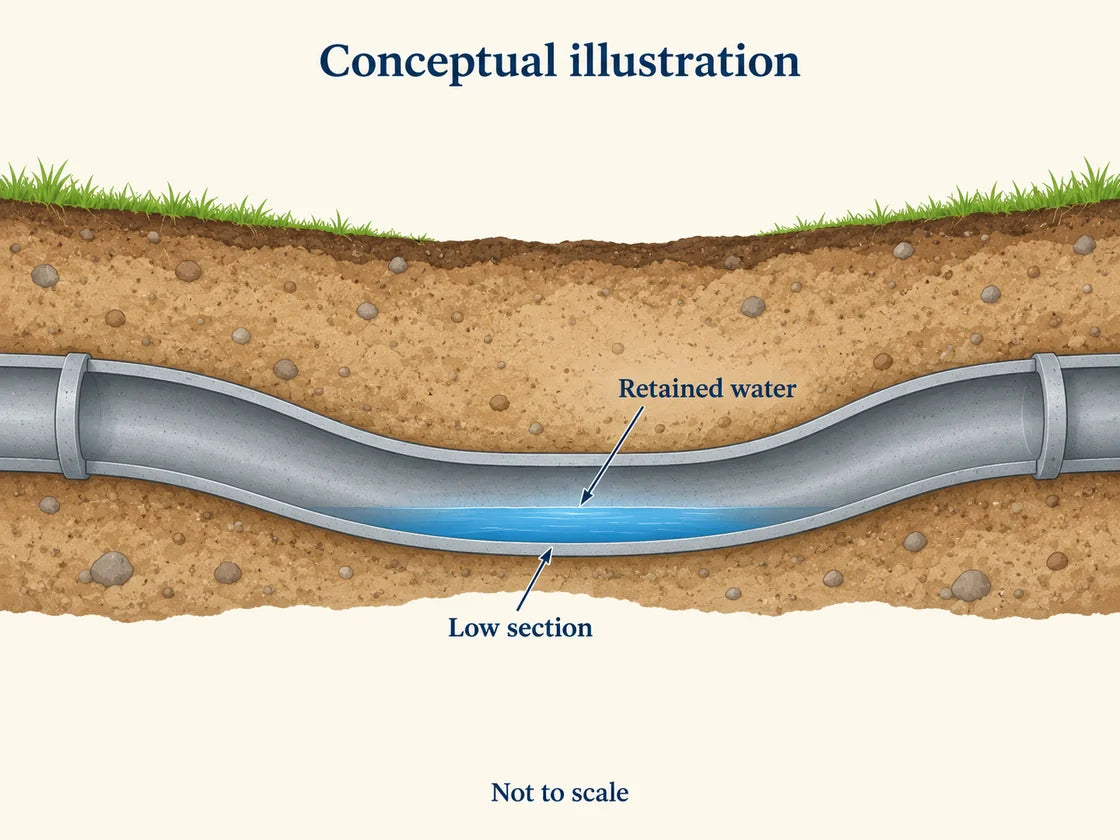
A sewer line belly is a low section of pipe that can retain water. Camera footage may support that finding, but one picture of standing water does not establish its cause, exact slope, or repair urgency. Ask for the complete recording, inspection conditions, entry point, and start-and-end distance notes. Have a qualified professional explain what remains unconfirmed before approving work.
Cover: conceptual illustration of a low pipe section holding water; not to scale, not a measured profile, and not real inspection footage.
↑ Back to topFive things to take away
- Separate the observation of water from the diagnosis of a belly.
- Ask which surfaces were visible and which were obscured.
- Keep the full recording and its distance reference together.
- Ask what additional evidence supports the proposed repair.
- Use the camera to inspect and document, not to clear or repair the line.
What does a sewer line belly mean?
In a residential inspection discussion, “belly” describes a dip or sag along the sewer pipe. A low section may hold water instead of draining through completely. The important question is whether the inspector has established that geometry, or is using the term as shorthand for water visible during the visit.
The EPA's condition-assessment white paper includes evidence of pipe sags among CCTV observations. It also explains that visual inspection has limits, including what can be seen beneath the waterline. This is established background on inspection methods, not a residential repair threshold or a diagnosis of your property.
Ask the inspector to put the finding into plain language: “We observed retained water in this section,” followed by “We believe the reason is…” and the supporting evidence. Keeping those statements separate makes it easier to understand what is known, what is suspected, and what a second contractor should investigate.
↑ Back to topWhat standing water on camera can show
A useful recording documents where the camera encountered water, how the view changed through that section, and what was visible before and after it. Request the surrounding footage rather than only the most dramatic still image. If the inspection ended in an obscured area, that endpoint belongs in the report.
NASSCO's assessment overview distinguishes visual CCTV from additional dimensional inspection methods. It emphasizes suitable equipment, lighting, centering, and focus. For a homeowner, the practical implication is simple: ask whether image quality was adequate for the particular conclusion being offered.
Make three columns in your notes: observed, interpreted, and unanswered. Under observed, record the inspector's description of the water and visible pipe surfaces. Under interpreted, record the suspected cause. Under unanswered, list anything the operator could not see or verify. Do not turn an unanswered item into either a clean bill of health or proof of damage.
For context on other visible conditions, use our guide to common sewer camera findings. Keep this belly discussion focused on the water finding instead of assuming every mark in the recording has the same cause.
↑ Back to topWhat the recording cannot establish by itself
Do not assign an exact slope, remaining service life, or mandatory excavation plan from a single frame. If a report includes numerical measurements, ask which instrument produced them, how the measurement was taken, and what limitations apply. A picture and a measured pipe profile are different kinds of evidence.
NASSCO notes that ordinary CCTV can clearly inspect the interior above the waterline. Treat an obscured lower surface as an inspection limitation. Ask how the provider will describe or investigate that uncertainty; do not accept “no visible defect” as confirmation about a surface that was not visible.
Likewise, a footage overlay needs a reference point. RIDGID's CountPlus documentation describes a cable-distance measuring device with zeroing and segment-measurement functions. That example illustrates why you should ask where the counter was zeroed. It does not establish the features or accuracy of a different camera system.
A note such as “water starts at 35 feet” is incomplete without the entry point, direction, and zero reference. Ask the contractor to distinguish the video distance from any separately established surface location. Do not use a footage number alone as an instruction about where to dig.
↑ Back to topQuestions that help test the interpretation
Before discussing a repair method, ask the provider to explain the conditions under which the footage was captured. These questions are a conversation checklist, not instructions to run water, open a cleanout, or conduct a test yourself.
- Was water being used in the house during this part of the recording?
- Was this footage taken before or after any cleaning or other service?
- Could a downstream restriction explain the water, and what was checked?
- Did the camera reach the intended endpoint, or was the inspection incomplete?
- Was the same section reviewed on withdrawal or during another pass?
- What evidence distinguishes a suspected low spot from a confirmed grade problem?
- Would another inspection condition or measurement change the recommendation?
NASSCO's inspection-quality guidance identifies flow conditions as one factor in configuring an inspection. Ask the operator to document those conditions in your own report. There is no need to borrow municipal testing procedures or apply another project's acceptance limits to your home.
If answers remain uncertain, ask for a written plan to resolve the uncertainty. A useful proposal explains what the additional step is meant to establish, who will perform it, and how its result would affect the repair recommendation.
↑ Back to topA practical evidence checklist
Before the provider leaves, request a package you can share with a second professional. Our inspection-report guide explains how to organize the broader report; use the following list for the belly finding.
- Full recording: Request the original available video, not only screenshots or a short phone clip.
- Route: Record the access point, inspection direction, intended endpoint, and actual endpoint reached.
- Distance reference: Ask where zero was set and request the start and end readings for the observed water.
- Conditions: Include known water use, service performed before filming, and visibility limitations.
- Finding: Ask for separate statements covering observation, suspected explanation, and confidence.
- Next step: Request the reason for reinspection, measurement, monitoring, or a repair assessment.
Keep service invoices and your own symptom notes with that package. Write down dates and what you noticed, without trying to diagnose the cause. For a property manager, identify the unit or property and the person who can arrange access so the next visit starts with the correct records.
↑ Back to topBefore approving a repair proposal
Ask for a recommendation tied to your documented finding. A proposal should make clear which problem the work is intended to address and what evidence supports that scope. If two contractors disagree, give both the same recording and written notes before comparing their explanations.
Use these questions when reviewing a quote:
- Which observed condition does this work address?
- What remains uncertain, and could that change the scope?
- If changing the pipe's grade is the objective, how will the proposed method achieve and verify it?
- What alternatives were considered, and why were they not recommended here?
- What access, restoration, permits, and exclusions belong in the written scope?
- What inspection or other evidence will document the result after the work?
A label such as “trenchless” or “replacement” is not enough to answer those questions. Ask the provider to describe the actual proposed work for your property. This article does not choose a repair technique, supply a universal acceptable water depth, or estimate a repair price from a video.
If monitoring is proposed, ask for a specific follow-up plan: what to record, who to contact, when to reassess, and what changes should prompt an earlier visit. Do not interpret a monitoring recommendation as a guarantee that the pipe will remain trouble-free.
↑ Back to topAn example of a clearer handoff
Illustrative example: A homeowner receives a short clip labeled “belly.” Instead of approving a repair based on that label, they request the full recording and ask the inspector to identify the access point, water section, and obscured areas. The inspector explains which conclusions are supported and what additional assessment is recommended.
The homeowner then sends the same package to a second provider with one question: “Does this evidence support the proposed scope, and what would you need to confirm before quoting?” No particular outcome is implied. The purpose is to make the next decision about the documented condition rather than the wording of a video caption.
That is Powerwill's Inspect Before Repair approach: use inspection to document what is visible, preserve uncertainty, and support a professional discussion. For repeat-use inspection work, build this recording-and-handoff routine into each job. A camera does not remove an obstruction, correct pipe grade, or replace the judgment needed to specify repairs.
↑ Back to topFrequently asked questions
Does standing water always mean a sewer line belly?
Do not treat the image alone as confirmation. Ask how the inspector distinguished a low section from other explanations and whether flow conditions, a possible restriction, and the rest of the inspected route were considered.
Can a camera measure the exact slope?
A single camera frame does not supply an exact slope measurement. If the provider reports a measured grade, ask for the equipment, method, and supporting record. Do not substitute a cable-distance number for that information.
Does a belly automatically mean digging?
The label alone is insufficient to approve excavation. Request a professional assessment linking the evidence to the proposed work, including unresolved questions and how the result will be verified. This guide does not determine whether a particular property needs repair.
What should I ask for if the camera went underwater?
Ask where visibility was lost, whether the intended endpoint was reached, and which surfaces could not be assessed. Keep the full recording and ask what follow-up would address the missing information.
Can cleaning or a camera fix a low section?
A camera inspects and records; it does not repair the pipe. If cleaning is proposed, ask which condition it addresses and whether the provider is also recommending further assessment of the suspected grade problem. Request distinct descriptions of service and repair.
Sources
Technical background checked October 21, 2026. These sources explain inspection principles; they are not property-specific diagnoses or residential acceptance criteria.
Comments
No comments