
Sewer Camera Inspection: Cost, Process, and DIY Options Explained (2026)
 MichaelCarter
0 comments
MichaelCarter
0 comments
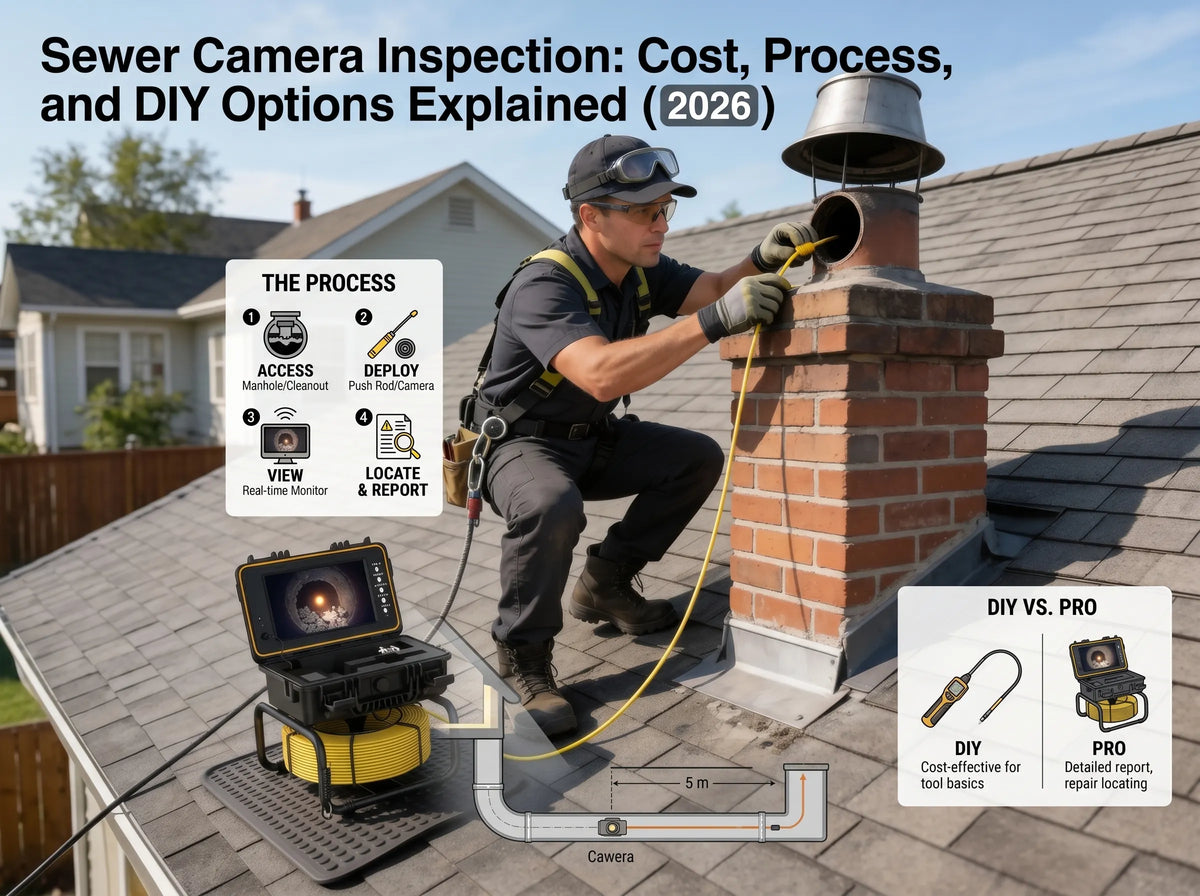
A sewer camera inspection is a diagnostic process where a licensed plumber — or you yourself — feeds a waterproof camera through your drain line to visually inspect the inside of your pipes. Most professional inspections cost between $125 and $500, take about 30–60 minutes, and can detect root intrusion, pipe cracks, blockages, and collapsed sections that no other method can find without digging. If you own multiple properties or deal with recurring drain problems, purchasing your own inspection camera — like the Powerwill PW9D1 starting at $595 — pays for itself after just one or two avoided plumber calls. This guide covers exactly how the process works, what it costs, what it finds, and when it makes sense to stop paying a pro and do it yourself.
What Is a Sewer Camera Inspection?
A sewer camera inspection is exactly what the name suggests: a real-time video look inside your drain and sewer pipes. A flexible fiber-optic or push-rod camera is fed through a cleanout access point (or through a toilet if no cleanout exists), traveling through your pipes while transmitting live video to a monitor. The plumber watches the feed, identifies any problems, and usually records it for documentation.

How the Technology Works
Modern sewer inspection cameras use a small waterproof camera head — typically 23mm to 30mm in diameter — mounted at the end of a semi-rigid fiberglass cable. The camera head is equipped with LED lights that illuminate the dark interior of your pipes, and many professional-grade cameras include a 512Hz sonde transmitter that emits a signal detectable from above ground, letting the plumber pinpoint exactly where underground problems are located.
The camera transmits footage to a monitor screen in real time. Professional units and consumer cameras alike record video and photos to a memory card so you have documentation of exactly what was found — and where.
Types of Sewer Cameras Used
Not all inspection cameras are the same:
- Push-rod cameras — The standard for residential inspection. A flexible cable with a camera head is manually pushed through the line. Best for main sewer lines and drain runs up to 200 feet.
- Lateral launch cameras — Used by municipal services to inspect branch lines off main sewer mains.
- Crawler/robotic cameras — Used in large commercial or municipal lines; not relevant for residential work.
For residential use, push-rod cameras handle 99% of inspection jobs — and that's what both plumbing contractors and DIY homeowners use.
↑ Back to topStep-by-Step: What Happens During a Sewer Camera Inspection
Understanding the process helps you know what you're paying for — and what to expect if you decide to run the camera yourself.

Before the Inspection
The plumber (or you) locates the sewer cleanout — a capped pipe typically 4 inches in diameter located in the basement, crawlspace, garage, or along the exterior foundation. If there's no cleanout, a toilet may need to be removed to access the drain. Expect an additional $50–$220 on a pro invoice if your home lacks an accessible cleanout.
The inspection works best when the line isn't completely blocked — if there's standing water or a full backup, that needs to be cleared first.
The Inspection Process
Once the camera enters the line, here's what happens:
- Insert and advance: The camera is fed slowly through the pipe — typically no faster than a few feet per minute to catch everything clearly.
- Monitor in real time: The plumber watches the monitor and narrates what they see.
- Track distance: A distance counter on the equipment records exactly how far into the line each finding is located.
- Locate underground (optional): If a 512Hz locator is used, a separate receiver above ground can pinpoint the underground location of any problem.
- Record everything: Video and still images are saved to a memory card for documentation.
The entire process usually takes 30–60 minutes for a standard residential main line.
After the Inspection: Reading Your Report
A professional inspection should end with a written or video report documenting: what was found, where (in feet from the access point), and what the recommended next steps are. Common outcomes are:
- All clear — no action needed; baseline documentation for future comparison.
- Partial blockage — hydro jetting or snaking recommended.
- Root intrusion — root cutting + periodic re-inspection, or pipe relining.
- Pipe defect — cracked section, offset joint, or belly (sag) — may require spot repair or relining.
- Collapse — rare but urgent; usually requires excavation and replacement.
What Can a Sewer Camera Detect?
The short answer: anything visual inside the pipe. A camera inspection is the only way to diagnose most sewer problems without digging up your yard.
Common Problems Found in Residential Sewer Lines
According to research by the U.S. Forest Service, root intrusion is responsible for more than 50% of all sewer line blockages in residential systems — making it the single most common thing a camera finds. Pipes built before 1970 (when clay and concrete were standard) show 3–5x higher rates of root intrusion than newer PVC lines.
Other common findings:
- Grease and buildup — especially in kitchen drain lines
- Pipe bellies / sags — where a section has settled and collects waste
- Cracked or broken pipe — from ground movement, tree roots, or age
- Offset joints — where pipe sections have shifted out of alignment
- Collapsed sections — complete pipe failure requiring excavation
A camera inspection can also confirm a line is clear and in good condition — which matters when buying a home or negotiating a repair estimate.
What It Can't Detect
A camera won't catch everything. It cannot:
- Detect pipe wall thickness or remaining pipe life (requires sonar or specialized assessment)
- Identify small hairline cracks that aren't yet leaking
- See into branch lines that split off from the main (without a lateral launcher)
- Tell you what's happening outside the pipe — like surrounding soil conditions
Sewer Camera Inspection Cost in 2026
Professional sewer camera inspections average $125–$500 for residential lines, with a national average around $280, according to data from Angi and HomeGuide (2026). Complex jobs or those requiring cleanout installation can reach $1,730 or more.
Typical Price Ranges by Service Type
| Service Type | Typical Cost |
|---|---|
| Standard residential line (with cleanout) | $125–$350 |
| No cleanout (toilet pull required) | $200–$500 |
| Pre-purchase home inspection add-on | $100–$250 additional |
| Emergency / after-hours inspection | Add $100–$300 |
| Inspection + 512Hz locator service | $350–$600 |
What Affects the Price
The biggest cost drivers are:
- Access — No cleanout means extra labor to pull a toilet or create access
- Line length — Longer runs cost more; some plumbers charge by the foot after 100 feet
- Location — Urban markets like LA, NYC, or Chicago run 30–50% above national average
- Time of day — Weekend and emergency rates are significantly higher
- Add-ons — Recording fees, locator service, and written reports may be billed separately
When Your Home Inspection Should Include One
Real estate professionals strongly recommend adding a sewer scope to any home purchase — especially homes older than 20 years. At $100–$250 added to a standard home inspection, it's cheap insurance against a $4,000–$15,000 sewer repair that would otherwise be discovered after closing.
↑ Back to topWhen Do You Actually Need a Sewer Camera Inspection?
You don't need one for every slow drain. But several situations make a camera inspection not just useful — but essential.
6 Situations That Warrant an Inspection
- Multiple slow drains at once — If more than one fixture drains slowly, the problem is downstream in the main line, not just one trap or branch pipe.
- Repeated clogs in the same drain — A drain that clogs every few months has a structural cause that snaking only temporarily fixes.
- Gurgling toilets or sewer gas smell — These signal a partial blockage or venting issue that needs visual confirmation.
- Buying a home — Especially homes built before 1984 when clay and cast iron pipes were standard.
- Visible roots in your yard near the sewer line path — If you have large trees between your house and the street, root intrusion risk is high.
- Before any major drain repair — Never approve a sewer repair estimate without a camera inspection first to confirm the actual problem and location.
How Often Should You Inspect?
For most homeowners with no known issues: every 3–5 years as preventive maintenance. If you've had root intrusion before: annually, or after every root-cutting treatment. For rental property owners managing multiple units: every 2–3 years per property.
Hiring a Pro vs. Owning Your Own Camera
Here's the math most plumbing articles don't do for you.
The True Cost of Repeated Inspections
If you're a property manager with 5 rental units and each line gets inspected every 3 years, that's roughly $700–$1,750 in inspection fees per cycle — plus you still have to schedule, wait for, and supervise each one. If any unit develops a recurring blockage issue, you could easily spend $250–$400 per call just on diagnostic work before any repair happens.
A homeowner who has dealt with two sewer backups in five years has already paid $500–$800 in inspection fees alone.
Who Should Consider Buying a Camera
The Powerwill PW9D1 costs from $595 and includes: a 9" HD monitor, 1080P self-leveling camera head, IP68 waterproofing, up to 165 feet of fiberglass cable, 12 adjustable LEDs, DVR recording, and a 32GB memory card. It handles every residential inspection scenario a push-rod camera can do.
The math works if you:
- Own more than 2 rental units
- Have recurring drain problems (more than 1 inspection per year)
- Are a property manager or maintenance professional
- Run a small plumbing or home inspection operation
- Simply want the ability to diagnose your own home without scheduling or waiting
At $595, the PW9D1 pays for itself after 2–4 professional inspections — then every future inspection is free. For professionals who need underground pipe locating capability, the Powerwill 10DX1 with built-in 512Hz locator delivers contractor-grade inspection capability starting at $1,630 — versus $5,000+ for comparable RIDGID equipment.
↑ Back to topKey Takeaways
- A sewer camera inspection is the only reliable way to diagnose pipe problems without digging. Most inspections cost $125–$500 and take under an hour — and they tell you exactly what's wrong, not just that something is wrong.
- Root intrusion causes more than half of all residential sewer blockages. According to U.S. Forest Service research, homes built before 1970 are 3–5x more likely to have root intrusion in older clay or concrete pipes than newer PVC systems.
- You need a camera inspection whenever multiple drains are slow, clogs repeat, or you're buying a home. Adding one to a pre-purchase home inspection costs just $100–$250 and can reveal $10,000+ repair needs before you close.
- No cleanout access raises your cost by $50–$220 on a professional invoice. If your home lacks an accessible cleanout, consider having one installed — it typically costs $600–$2,000 but pays back on every future inspection or emergency call.
- Owning a camera like the Powerwill PW9D1 ($595) makes financial sense after 2–4 professional inspections. For property managers, landlords, or anyone with recurring drain issues, buying outright eliminates scheduling delays and ongoing inspection fees permanently.
FAQ — Sewer Camera Inspection Questions
Can a homeowner do a sewer camera inspection themselves?
Yes — consumer-grade push-rod inspection cameras like the Powerwill PW9D1 are specifically designed for non-professionals. The process is straightforward: locate your cleanout, feed the cable in, and watch the monitor. No special license is required to inspect your own property.
The main learning curve is reading what you see on the monitor — root intrusion, bellies, and offsets each look distinct once you've seen them once. Most homeowners feel confident after their first pass.
How long does a sewer camera inspection take?
A standard residential main line inspection takes 30–60 minutes for a professional. DIY inspections on your own line typically take a similar amount of time on the first pass — and get faster once you're familiar with your pipe layout.
What is the difference between a sewer scope and a sewer camera inspection?
They're the same thing — "sewer scope" is simply the industry term more common in real estate contexts, while "sewer camera inspection" is more common in plumbing service contexts. Both refer to running a video camera through your drain line to inspect it.
Does a sewer camera inspection find the exact location of a problem?
It tells you how far into the pipe (in feet) the problem is. If the camera includes a 512Hz sonde transmitter, a receiver held above ground can also locate the exact physical position of any finding — essential for planning excavation or repair.
The Powerwill 10DX1 includes a 512Hz locator; the PW9D1 has a locator-compatible upgrade available.
Will a sewer camera inspection damage my pipes?
No. A push-rod camera travels through the pipe without applying force against the pipe walls. There's no abrasion, no pressure, and no chemical contact. The only risk is the camera getting stuck in a severe collapse — which itself is a diagnostic finding, not damage caused by the inspection.
Should I get a sewer inspection before buying a house?
Every time — especially for homes over 20 years old. Sewer and drain issues rank among the most expensive and most commonly missed items in standard home inspections, which don't include a camera scope. The $100–$250 add-on is the highest-ROI optional inspection available when purchasing a home.
What happens if the camera finds a problem?
Your plumber will present a repair recommendation. Common options include hydro jetting (for blockages/grease), root cutting (for root intrusion), pipe relining (for cracks or offset joints), and excavation + replacement (for collapses).
Get the video documentation before signing any repair order — it's your proof that the repair is actually needed and the best leverage you have when getting second opinions.
Ready to Stop Paying for Inspections You Can Do Yourself?
A sewer camera inspection is one of the most informative — and most overpriced — diagnostic services in residential plumbing. For anyone dealing with repeat drain issues or managing more than one property, owning your own camera shifts the math dramatically.
Ready to take control of your own pipe inspections? The Powerwill PW9D1 gives you a professional-grade self-leveling inspection camera with a 9" HD monitor, 1080P video, DVR recording, and up to 165 feet of cable — for $595. That's less than three professional inspection callouts. Backed by a 1-year warranty and US-based support out of Houston, TX. → Shop the Powerwill PW9D1 Camera System
Comments
No comments