
How to Choose a Sewer Camera for Your Plumbing Business: The 2026 Professional's Guide
 Michael Carter
0 comments
Michael Carter
0 comments
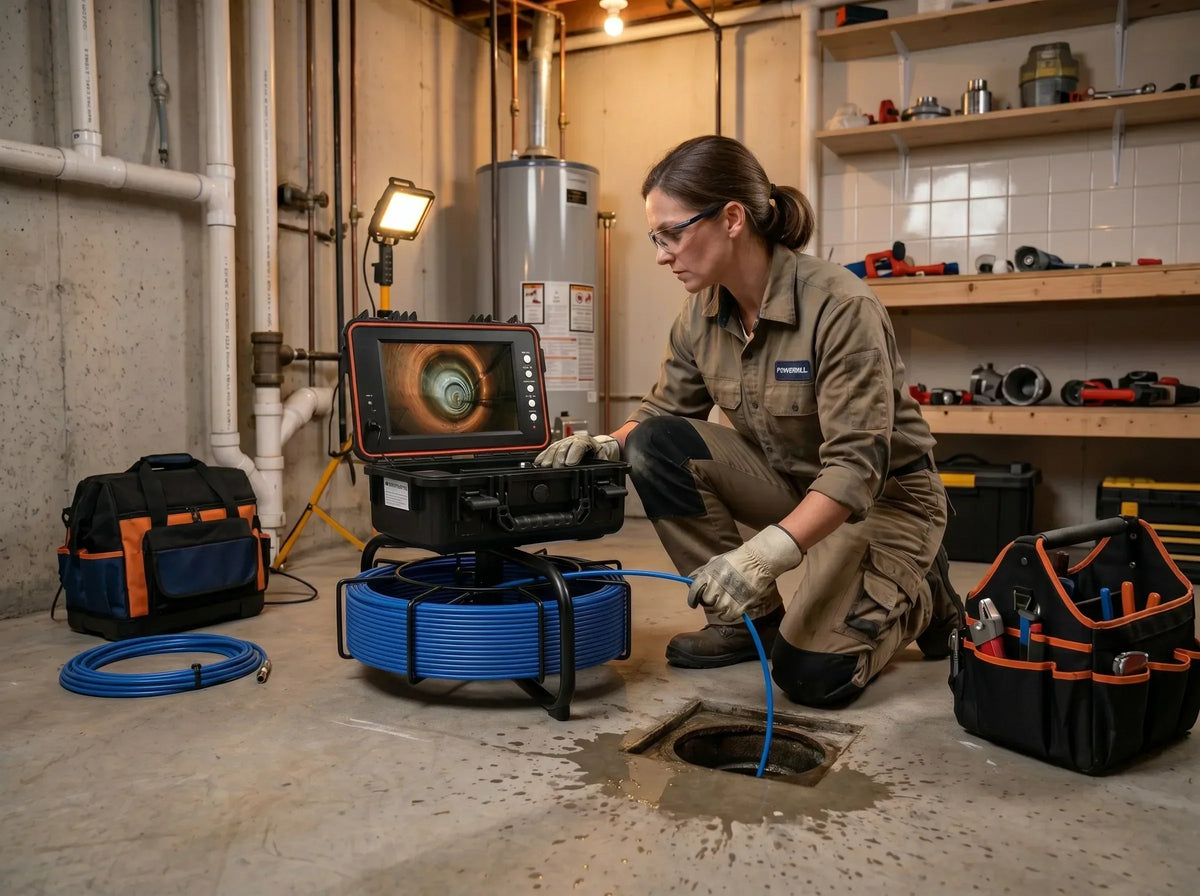
Choosing a sewer camera for your plumbing business comes down to three questions: how far do your jobs actually go, do you need to locate the camera underground, and what will you charge per inspection? Match those three answers to the right camera tier — and you'll have a tool that pays for itself within weeks, not years. Plumbers charging $250–$400 per residential sewer inspection typically recoup a mid-range camera ($550–$700) after just 2–3 jobs. This guide walks you through every spec that matters, the ones you can skip, and exactly which Powerwill model fits each type of plumbing operation.
Why Your Camera Choice Is a Business Decision, Not Just a Tool Purchase
Most buying guides treat sewer cameras like consumer gadgets. For a plumber, it's closer to hiring an employee — the camera generates revenue on every job it runs.
According to Angi (2026), the national average for a residential sewer camera inspection is $280–$350. Some markets charge $400–$500. If you run four inspections per week, a $700 camera pays for itself in a single week. A $1,630 professional-grade unit pays for itself in roughly 5–6 jobs.
The math changes your mindset. Instead of asking "can I afford this camera?", the right question is "how many jobs until this camera is free?" — and the answer is almost always sooner than you think.
- Lands upsell work. A clear recorded video of root intrusion or a cracked pipe is the most effective sales tool you'll ever have. Customers authorize repairs they can see.
- Protects you legally. A timestamped video of pre-existing damage before you start work is your liability shield.
- Differentiates you. According to a 2025 ServiceTitan survey, plumbers who offer camera inspection as a standalone service close 34% more repair jobs than those who don't.
The 5 Specs That Actually Matter for Professional Use
1. Cable Length: Match Your Market, Not the Maximum
Cable length is the single most important spec — and the most over-bought.

If 80% of your work is residential drain clearing, a 100 ft cable handles nearly every job. Buying 246 ft "just in case" adds weight, complexity, and cost with very little field payoff.
2. Self-Leveling: Non-Negotiable for Professional Use
A non-self-leveling camera head rotates as your cable twists through bends. For a plumber running 5–10 jobs per week, it's slow, tiring, and produces footage that's hard to explain to customers. Self-leveling cameras use a gravity-compensating bearing — no matter how the cable twists, the image stays upright. According to plumbers on professional trade forums, self-leveling cameras cut inspection time by 20–30% on jobs with multiple bends. Every Powerwill camera includes self-leveling standard.
3. 512Hz Locator: Only If You Dig
The 512Hz sonde transmitter lets you track the camera head underground from the surface — within inches. You need it if your work requires excavation or pre-construction pipe surveys. You don't need it if you only clear blockages and report findings. The Powerwill 7DVE includes a 512Hz locator at mid-range price. Not sure? Buy without — add a standalone Powerwill 512Hz Sonde Receiver Kit ($372.95) when you need it.
4. Recording + Screen Quality: Your Sales Tool on Every Job
Customers authorize work based on what they see. The professional minimum bar: 1080P on the camera head, 7" screen or larger, DVR with SD card recording, and a distance counter — "root intrusion at 47 feet" is infinitely more useful than "somewhere past the second bend."
5. Camera Head Diameter: Often Overlooked
Powerwill's 23mm head (on the 10DX1 and 7DA) fits pipes as small as 2". The PW9D1 accommodates 1"–6" pipe. Check your typical job profile before buying — a head that won't enter your most common pipe size is a paperweight.
↑ Back to topThe 3 Camera Tiers for Plumbing Businesses
Tier 1 — Starting Out ($550–$700)
Best for: Plumbers adding camera inspection as a new revenue line, residential-focused operations.
Recommended: Powerwill PW9D1 — from $595
- 9" IPS screen, 5× digital zoom, 1080P IP68 camera head, 140° wide angle
- Self-leveling, DVR with 32GB SD card, ~10 hours battery life
- 65ft, 100ft, or 165ft cable options; ~14 lbs — fits in a truck bed without a cart
At $595, the PW9D1 pays for itself after 2 residential inspections at standard market rates.
Tier 2 — Active Plumbing Business, Daily Use
Best for: 5+ inspections/week, mixed residential/light commercial.
Recommended: Powerwill 7DA — $550 (7" IPS, 100ft cable, self-leveling, DVR). Need a locator? The 7DVE adds 512Hz for a small premium.
Tier 3 — Full Professional/Commercial ($1,630+)
Best for: Licensed inspection contractors, 10+ camera jobs/week, commercial sewer work.
Recommended: Powerwill 10DX1 — from $1,630
- 10" IPS screen; 7mm fiberglass cable, 200ft or 246ft options
- 23mm camera head, 110° FOV, 12-LED ring, 1080P, IP68, self-leveling
- Full keyboard with meter counter; DVR up to 128GB; 512Hz locator option; fits 2"–8" pipe
- Compare to RIDGID SeeSnake at $5,000–$8,000 — the 10DX1 delivers comparable spec at one-third the price
What Cheap Cameras Actually Cost You

Powerwill cameras are built with replaceable components. Replacement heads and cables available at powerwill.com/collections/replacement-kits. One replacement head vs. buying a whole new camera every 18 months — that's the actual lifetime cost difference.
↑ Back to topKey Takeaways
- Match cable length to your actual job profile. Most residential plumbers are fully served by 100ft. Buy longer only when commercial work demands it.
- Self-leveling is non-negotiable for professional use. It speeds up every inspection and produces footage customers understand. Every Powerwill model includes it standard.
- Only add the 512Hz locator if you dig. Unnecessary overhead for drain clearing and reporting work.
- Your recording quality is your sales tool. 1080P video with a distance counter and timestamp gets repair jobs authorized on the spot.
- Cheap cameras cost more over time. Non-replaceable heads, kinking cables, and missing documentation features end up costing more than a purpose-built professional camera.
FAQ — Choosing a Sewer Camera for Your Plumbing Business
What's the best sewer camera for a plumber just starting out?
The Powerwill PW9D1 ($595) is the best starting point. Compact, self-leveling, 1080P, handles 95% of residential work. Pays for itself after 2–3 inspections at standard market rates.
How much can a plumber charge for a sewer camera inspection?
According to Angi (2026), the national average is $280–$350. High-cost markets (California, New York, Chicago) reach $400–$500. A plumber running 4–5 inspections per week generates $1,200–$2,000/week from camera work alone.
Do I really need a 512Hz locator?
Only if excavation is required. If you only diagnose and report findings, a camera without a locator works perfectly. Add the Powerwill 512Hz Sonde Receiver Kit ($372.95) later when you need it.
How long does a professional sewer camera last?
5–8 years with proper maintenance (wipe cable after each job, clean lens, coil without kinks). Powerwill's replaceable heads and cables mean you replace the worn component — not the entire unit.
What's the difference between the Powerwill PW9D1 and 10DX1?
PW9D1: compact residential system, 9" screen, up to 165ft, ~14 lbs, from $595. 10DX1: full professional platform, 10" screen, 246ft, keyboard controller with meter counter, 2"–8" pipe, from $1,630. Both are self-leveling and 1080P.
Can I use a Powerwill camera for commercial sewer inspections?
Yes — the 10DX1 with its 246ft cable and 23mm IP68 head is rated for commercial building laterals on pipes up to 8" diameter. For 12"+ municipal main lines, you'd need a tractor-based system.
How do I justify the camera purchase to my business partner?
$300/inspection × 4 jobs/week = $1,200/week in new revenue. A $700 camera is paid off week 1. A $1,630 camera in under 2 weeks. Plus: documented video increases repair close rates by 20–30%.
Conclusion
The right sewer camera isn't the most expensive one you can afford — it's the one that matches your actual job profile and starts generating ROI from the first week. A residential plumber doing 4–5 inspections weekly needs a compact, reliable camera with a 100ft cable, clean 1080P recording, and a screen large enough to show customers on-site. That's the Powerwill PW9D1 at $595, and it pays for itself faster than nearly any other tool in your van.
As your inspection volume grows or you start doing commercial work that requires underground locating, the upgrade path to the 7DA or 10DX1 is clear — and your original investment remains useful for residential work.
Ready to add camera inspection to your service menu? Shop Powerwill Sewer Cameras — the PW9D1 starts at $595 with self-leveling, 1080P recording, and a 9" screen built for job-site use.
Comments
No comments