
Borescope vs. Sewer Camera: Which Tool Does What (And When You Need Both)
 Michael Carter
0 comments
Michael Carter
0 comments
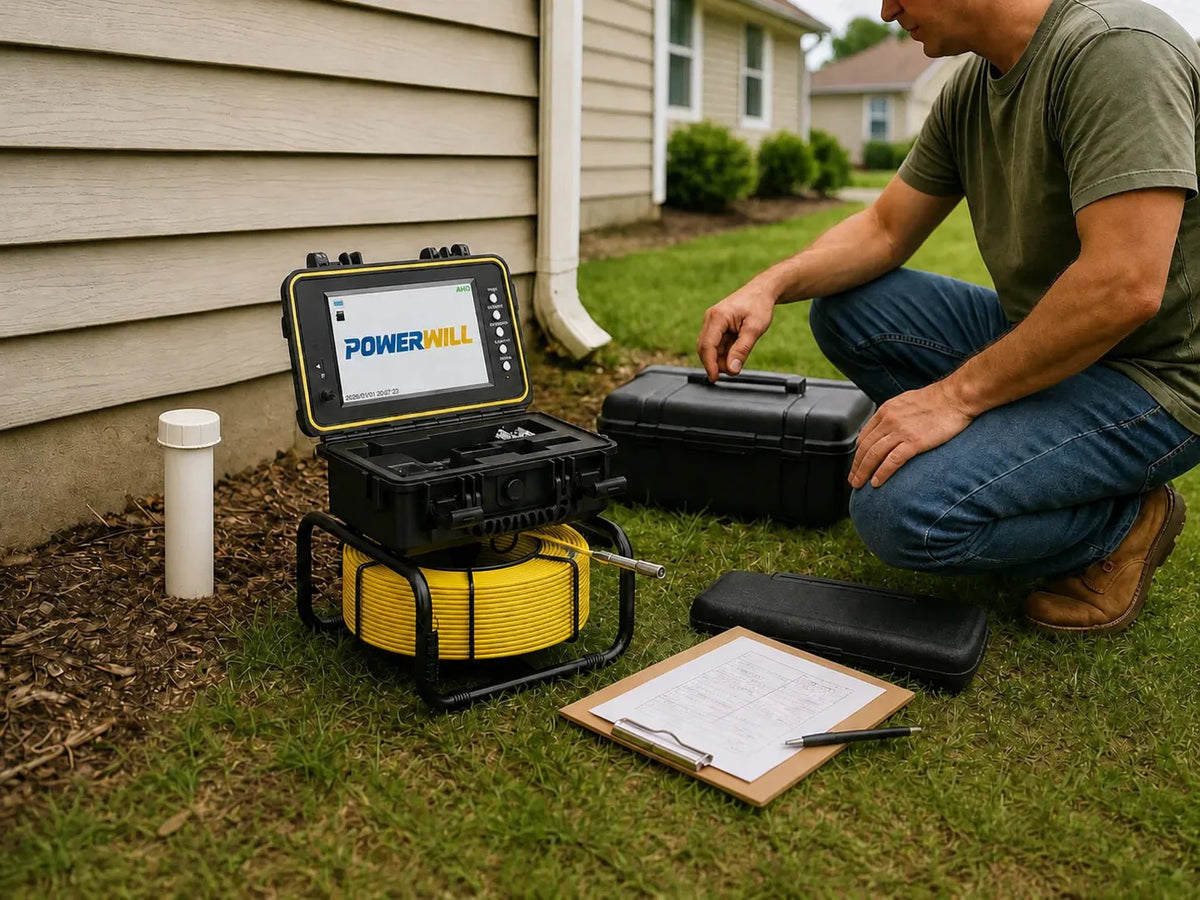
A borescope and a sewer camera solve two different inspection problems, even though both use a camera on a cable. A short inspection scope like Milwaukee's M12 M-SPECTOR 360 uses a 3-foot cable with a 9 mm camera head for tight cavities, while Powerwill's PW9D2 sewer camera runs from 64 to 230 feet with a self-leveling head and 512 Hz locating option. If you need to see behind drywall, under an appliance, or inside a short duct, buy a borescope. If you need to inspect a buried drain, main sewer, or long branch line before paying for excavation, buy a sewer camera instead.

What a Borescope Is Actually Built For
A borescope is designed for close-range inspection in tight spaces where the operator can stay physically near the target area. That usually means wall cavities, engine bays, equipment housings, behind toilets, under tubs, or short sections of vent and duct work.
Milwaukee's M12 M-SPECTOR 360 is a good benchmark because it spells out the job clearly: a 3-foot cable, 9 mm head, and rotating screen for "the tightest of spaces." That is a great feature set when maneuverability matters more than reach.
Consumer inspection scopes follow the same pattern. DEPSTECH's 2K dual-lens borescope uses a 16.5-foot semi-rigid cable and IP67 waterproofing, which is fine for short checks but still nowhere near a long buried lateral. So a borescope is not the wrong tool because it is cheap. It is the wrong tool when the inspection path is much longer, wetter, or more forceful than it was built to handle.
Back to topWhat a Sewer Camera Is Built For
A sewer camera is built for long wet runs, not just peeking into a hidden spot. It uses a tougher push cable, a larger waterproof camera head, stronger skids, brighter lighting, and usually a screen that can support documentation and repeat review.
The Powerwill PW9D2 lists 64-foot to 230-foot cable options, a 9-inch IPS monitor, built-in DVR, distance counter, IP68 waterproofing, and a 512 Hz transmitter. Powerwill also says it fits 25 to 150 mm straight pipes and 50 to 150 mm right-angle pipes. That specification set tells you immediately that this is a drain-and-sewer diagnostic platform, not a wall-cavity gadget.
If the job involves a cleanout, underground drain, recurring backup, or repair estimate, a sewer camera earns its cost by giving you reach, location data, and footage you can actually act on later.
Back to topThe Biggest Differences That Decide the Buy
| Category | Borescope | Sewer camera |
|---|---|---|
| Typical reach | About 3 to 16.5 feet on common contractor and consumer units. | About 64 to 246+ feet on residential and pro drain systems. |
| Camera head | Small heads like 9 mm are built for narrow access. | Larger heads like 23 mm use skids and stronger housings for pipe travel. |
| Water rating | Often splash resistant or IP67. | Typically IP68 for full wet-pipe use. |
| Cable stiffness | Good for short steering, weak for long pushing. | Built to push farther through turns and standing water. |
| Location workflow | Usually no surface locating. | Often includes distance counter and 512 Hz locating. |
| Best use | Equipment, cavities, short diagnostic peeks. | Drain lines, sewer laterals, buried pipe, repeat repair decisions. |
The price logic follows the hardware difference. The borescope is meant to answer "what is in this tight spot?" The sewer camera is meant to answer "what is happening 47 feet into this line, and where do I dig if it is broken?" Those are completely different buying jobs.
Powerwill's drain camera collection currently starts around $372.95 for the PW9D1, while many contractor borescopes cost far less because they are not trying to solve the same problem. Low price alone is not a comparison if the inspection path is different by 50 to 200 feet.
Back to topWhen You Need Both Tools Instead of Choosing Only One
You need both tools when the diagnosis starts in a tight access area but may continue into the drain line itself. A common example is a bathroom remodel where you first use a borescope to inspect behind the wall or under the tub, then use a sewer camera through the cleanout to verify that the branch line or main line is actually clear.
Another example is HVAC and condensate work. Powerwill says the 7DVE can be used for sewer, drain, and HVAC inspections, but that does not mean a sewer camera replaces a borescope in every air-side cavity. It means the sewer camera is still valuable once the path becomes long, wet, or inaccessible from both ends.
Which Powerwill Camera Makes Sense After the Comparison
If this comparison confirms that you really need a sewer camera, choose the Powerwill reel by pipe type and run length, not by the word "camera" alone. The PW9D2 is the clean middle ground for many homes and contractors because it combines longer reach, 512 Hz locating, and self-leveling video in a still-portable package.
If your jobs are mostly smaller residential drains and shorter checks, the PW9D1 range gives a lower entry price while keeping the inspect-before-repair workflow. If your work moves into longer mains and more demanding professional runs, the 10DX1 adds 246 feet of reach, a 10-inch monitor, and pro-grade locating.
The honest conclusion is simple: buy a borescope when access is tiny and the run is short. Buy a sewer camera when the pipe itself is the job.
Back to topKey Takeaways
- A borescope is a short-range inspection tool for tight cavities, not a substitute for a drain-line camera.
- A sewer camera is built for long, wet pipe runs with stronger cable, brighter lighting, and documentation features that matter for repair decisions.
- Reach, waterproof rating, cable stiffness, and locating support matter more than the generic word camera when you compare the two tools.
- Many real jobs need both tools in sequence, especially when you inspect a cavity first and a buried line second.
- If the line itself is the question, a Powerwill sewer camera such as PW9D2 or 10DX1 is the more honest fit than trying to stretch a borescope past its design limits.
FAQ
Can a borescope inspect a sewer line?
Only in a very limited way. A borescope may help at the opening of a pipe, but it is usually too short and too lightly built for a full sewer or drain run.
Why is a sewer camera more expensive than a borescope?
Because it has to push much farther, survive full wet-pipe conditions, and often support recording, distance tracking, and locating. Those are heavier-duty requirements than a short inspection scope needs.
When should a homeowner buy both tools?
Usually only if you do a lot of DIY troubleshooting in different systems. Most homeowners need one or the other, and for pipe problems the sewer camera is normally the better investment.
Can a sewer camera replace a borescope inside walls?
No. The camera head is usually larger and the cable is built for pushing through pipe, not for delicate short-range maneuvering inside a tight cavity.
Which Powerwill camera is the best next step if I need real pipe diagnostics?
The PW9D2 is a strong all-around choice for residential and light contractor use. If you need longer runs and a larger workstation, move up to the 10DX1.
Conclusion
Borescope versus sewer camera is not a brand argument. It is a job-fit argument. Once you separate short cavity inspection from long pipe inspection, the buying decision becomes much clearer and much cheaper.
If your real goal is to inspect before you repair, start with the Powerwill drain and sewer camera lineup and match the reel to the pipe run instead of forcing a borescope into a sewer job.
Back to topSources
Choose your next step
Use these Powerwill pages to move from research to the right model, locator workflow, or product comparison.
Comments
No comments