
The Real Cost of Not Owning a Sewer Camera: Revenue You're Leaving on the Table
 Michael Carter
0 comments
Michael Carter
0 comments
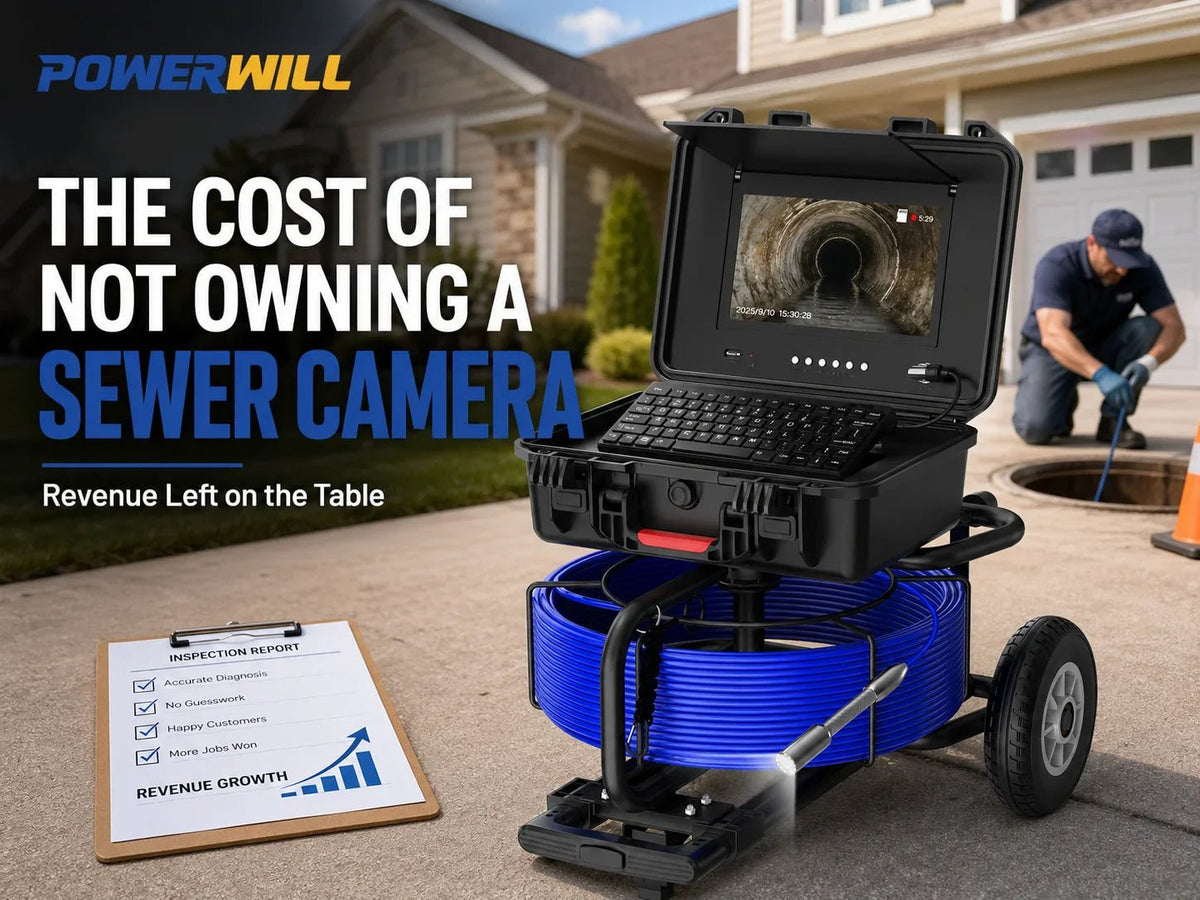
If you run a plumbing business and still have to refer sewer camera work out, the cost is bigger than the inspection fee you miss that day. Current 2026 homeowner pricing puts many sewer camera inspections in the $125 to $500 range, with a $280 national average, so even a modest inspection count can become meaningful annual revenue. The bigger win is that the plumber who controls the footage usually controls the quote, the repair conversation, and the follow-up work too.

Why no camera is more expensive than it sounds
The direct cost of not owning a sewer camera is easy to see. A customer calls about repeated backups, slow drains, or a pre-purchase sewer scope. If you cannot offer the service, you either turn the lead away or hand it to someone else.
The more important cost is what happens next. The plumber who performs the inspection becomes the person who shows the customer the root intrusion, crack, belly, or offset. That same plumber is usually the first one trusted to quote the repair.
HomeGuide's current cost guide says a sewer camera inspection averages $280 and usually lands between $125 and $500. Angi's current guide shows a wider overall range of $270 to $1,730 and notes that standard inspections commonly run $150 to $300 before premium reporting or specialty equipment. If your truck does not have a camera, you are opting out of a service customers are already willing to buy.
↑ Back to topWhat one missed camera job per week is actually worth
The cleanest ROI math starts with the inspection fee itself. Using the $280 national average from HomeGuide as a conservative benchmark, the revenue you give up each year adds up quickly.
| Missed inspection volume | Revenue missed at $280 each |
|---|---|
| 1 per week | $14,560 per year |
| 2 per week | $29,120 per year |
| 3 per week | $43,680 per year |
| 5 per week | $72,800 per year |
That table still understates the opportunity. Angi also lists common add-ons like $50 to $150 for video or reporting, $40 to $100 for locating, $75 to $200 per extra branch line, and $100 to $300 for emergency service. If your business does not own the camera, those profitable small-ticket add-ons go to someone else too.
↑ Back to topThe bigger loss is the repair work you never get to quote
The inspection fee is only the first layer. The larger business loss is the repair opportunity that follows the inspection.
Angi's April 5, 2026 guide says the average sewer line repair cost is about $2,600, with many jobs between $1,100 and $4,100. Its March 17, 2026 replacement guide puts typical sewer line replacement at $1,388 to $5,323, with trenching, restoration, and longer runs pushing some projects higher.
That means a missed inspection can also mean a missed cleaning, lining, repair, or replacement quote. You do not need a heroic close rate to make the ROI work. A conservative example is enough:
- You miss 1 camera inspection per week at the $280 average.
- You fail to win just 1 average sewer repair per quarter because another company handled the diagnosis first.
- You use Angi's $2,600 average repair value for that quarterly repair.
That is a modest scenario, not an aggressive one. Many shops will see more than one camera call a week, and many camera calls uncover revenue beyond a plain repair ticket.
↑ Back to topWhy diagnostics matter more in 2026
Customers still care about price, but they increasingly want proof before they approve major work. The camera is what turns a suspicion into something visible and billable.
The EPA says sanitary sewer overflows can back up into homes, cause property damage, and threaten public health. It also estimates there are at least 23,000 to 75,000 sanitary sewer overflows per year in the United States, not counting sewage backups into buildings. For a homeowner staring at a four-figure quote, that makes visual evidence far more persuasive than a verbal diagnosis.
Owning the diagnostic step lets you inspect first, show the footage, quote from evidence, and save the video for the customer, realtor, GC, or insurer. Operationally, it also reduces weak estimates and helps your crew return with the right plan instead of guessing on the first visit.
↑ Back to topHow fast a Powerwill camera can pay for itself
Powerwill's current lineup gives a practical ROI benchmark because it covers both entry-level and longer-run professional work.
Powerwill's official pages currently show the 7DA from $835.99, with a 7-inch screen, 100 ft cable, self-leveling camera head, IP68 waterproof rating, and built-in 512Hz locating. Powerwill's current selection guide lists the 10DX1 from $1,399, while the live 246 ft product page shows the 246 ft / 75 m with 512Hz locator variant at $1,630.77. The 10DX1 platform uses a 10-inch screen, distance counter, and up to 264 ft of cable for longer main-line work.
| Camera setup | Current reference price | Inspections to recover equipment cost |
|---|---|---|
| Powerwill 7DA | $835.99 | About 3 jobs |
| Powerwill 10DX1 | From $1,399 | 5 jobs |
| Powerwill 10DX1, 246 ft with locator | $1,630.77 | About 6 jobs |
At two booked camera jobs per week, the 7DA can recover its cost in roughly two weeks, while the larger 10DX1 can recover its cost in about three weeks. After that, the camera is no longer a cost center. It is a paid-off diagnostic platform feeding new quote opportunities into the truck.
↑ Back to topWhich setup makes sense for which plumber
Not every shop needs the same camera on day one. The right fit depends on your call mix, pipe sizes, and whether you need locating on typical jobs.
If you mainly want to stop referring residential scope work out
The 7DA is the straightforward starting point. Powerwill positions it for everyday residential and light-commercial work, with a 100 ft push cable, self-leveling camera, 120-degree lens, and locating support. If your current issue is simply that your truck has no camera at all, this gets you back into the conversation fast.
If camera work will be a regular revenue line
The 10DX1 makes more sense. Powerwill's current selection guide describes it as an all-in-one system built for long, straight 2-inch to 12-inch main sewer lines. The longer push rod, 10-inch monitor, and distance-aware workflow are a better fit when you already know short residential reels are not enough.
If the real issue is credibility
Either model helps because the business change is bigger than the spec sheet. The moment your dispatcher can say, "Yes, we can scope that today and show you the footage," your company stops sounding like a shop that guesses and starts sounding like a shop that diagnoses.
The opportunity cost is cumulative
One week without a camera is annoying. One year without a camera becomes a business pattern.
If you keep missing one inspection per week, the direct diagnostic revenue loss alone is already meaningful. Add a handful of missed repair wins, a few locating add-ons, and the fact that another plumber becomes the customer's trusted problem-solver, and the gap widens even if your core plumbing work stays busy.
That is why the real cost of not owning a sewer camera is cumulative. It is not just the tool you have not purchased yet. It is the stack of jobs, quotes, and repeat relationships that quietly migrate to the company that brought a camera to the first visit.
↑ Back to topKey Takeaways
- A sewer camera creates more than inspection revenue. It also creates the evidence you need to quote cleaning, repair, and replacement work with confidence.
- At HomeGuide's current $280 average, one missed camera call per week is about $14,560 a year. That is before locating, reporting, or emergency add-ons.
- Using Angi's current $2,600 average sewer repair cost, one extra average repair per quarter adds another $10,400 a year. That makes a conservative ROI case without stretching assumptions.
- Powerwill's current pricing puts the 7DA at roughly a 3-job break-even and the 10DX1 at about a 5- to 6-job break-even. For most active shops, that is measured in weeks, not years.
- If your shop still refers camera work out, the biggest loss is strategic. You are letting another plumber own the diagnosis, the repair conversation, and the future customer relationship.
FAQ: Sewer Camera ROI for Plumbers
How much can a plumber realistically charge for a sewer camera inspection?
Current public homeowner pricing shows a wide range, but many standard residential inspections land around $250 to $400. HomeGuide shows a $280 national average, while Angi places many standard jobs in the $150 to $300 band before add-ons.
How many inspections does it take to pay off a sewer camera?
At a $280 average inspection fee, a camera around $835.99 takes about 3 jobs to recover. A camera around $1,399 to $1,630.77 takes about 5 to 6 jobs.
Is the inspection fee the main reason to own the camera?
No. The inspection fee matters, but the larger value is owning the diagnostic step that leads to cleaning, locating, and repair quotes. The camera turns "I think" into "here's what the line shows."
Do I need a locator right away?
If you regularly need to mark the spot before excavation or want to sell locating as part of the visit, yes. Powerwill's current 7DA and 10DX1 options both support 512Hz locating, which makes the scope much more useful when exact position matters.
Which Powerwill camera is the better starting point for a smaller shop?
If you mainly want to stop turning away residential scope work, the 7DA is the lower-cost entry point. If you already know your shop needs longer reach, larger mains coverage, and a more fully featured setup, the 10DX1 is the stronger long-run platform.
Conclusion
The real cost of not owning a sewer camera is not the equipment price on the website. It is the inspection revenue, repair revenue, and customer trust that keeps sliding to the plumber who arrives ready to diagnose on the first visit.
If you want to stop referring that work out, start with the setup that matches your call volume. Powerwill's current lineup gives small shops and growing plumbing businesses a practical entry path, from the 7DA for everyday residential work to the 10DX1 for longer professional runs. Compare the current options here.
Plan Your Inspection Before You Dig
Use Powerwill guides and tools to confirm what is happening underground before committing to repair work.
Comments
No comments